
Forex analysis review |
- EURUSD: Much more. Another fly in the ointment for the euro from ECB economists
- The US GDP report provided strong support to the dollar
- The dollar wiped its nose to all skeptics
- GBP/USD: plan for the American session on July 26. The pound continues to lose ground even at the end of the week
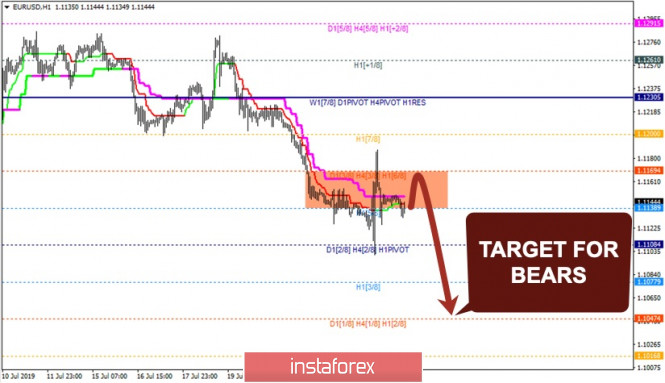
- EUR/USD: plan for the American session on July 26. Trade will remain on the channel until the end of the week, despite a
- EUR/USD for July 26,2019 - Support on the test
- Silver analysis for 07.26.2019 - New up move is on the way
- July 26, 2019 : EUR/USD Intraday technical analysis and trade recommendations.
- BTC 07.26.2019 - Downward pressure and bear flag in creation
- July 26, 2019 : GBP/USD Intraday technical analysis and trade recommendations.
- Wave analysis of EUR / USD and GBP / USD for July 26. US GDP may again please bears in both pairs
- Trading recommendations for the EURUSD currency pair - prospects for further movement
- Euro has had a short euphoria after the ECB meeting: will the Fed launch a "bearish" game against the dollar?
- Gold to extend rally
- Technical analysis of GBP/USD for July 26, 2019
- Technical analysis of USD/CAD for July 26, 2019
- Australian dollar forecast decline
- EUR/USD: bears to push price even lower soon
- Trading recommendations for the GBPUSD currency pair - prospects for further movement
- Analysis of NZD/TRY for July 26, 2019: bearish trend to continue
- Funny jumps on the spot (a review of EUR / USD and GBP / USD as of 07.26.2019)
- ECB disappointed financial markets (We expect a continuation of the local fall of the AUD/USD pair and the growth of USD/CAD
- The EU strongly rejected Boris Johnson's claims, Euro and pound are down
- EURUSD: Draghi is preparing the markets for lower rates, but the potential of EURUSD reduction is limited
- Forecast for Bitcoin on July 26th. Germany introduces licensing of all crypto companies
| EURUSD: Much more. Another fly in the ointment for the euro from ECB economists Posted: 26 Jul 2019 08:11 AM PDT Today is practically empty for fundamental data that could have led to at least any change in the current market situation. Economists continue to analyze yesterday's series of statements by the President of the European Central Bank, which still keeps major players from further action before the weekend. Let me remind you that yesterday, Mario Draghi noted a good growth in employment and wages, which continue to support the economy, but pointed to the threat of protectionism and geopolitical factors that increasingly affect business and worsen market sentiment. The European Central Bank also signaled its readiness to reduce interest rates and, together with the launch of a number of mitigating measures. However, it should be noted that this meeting did not discuss the scale of rate cuts and the volume of asset purchases.
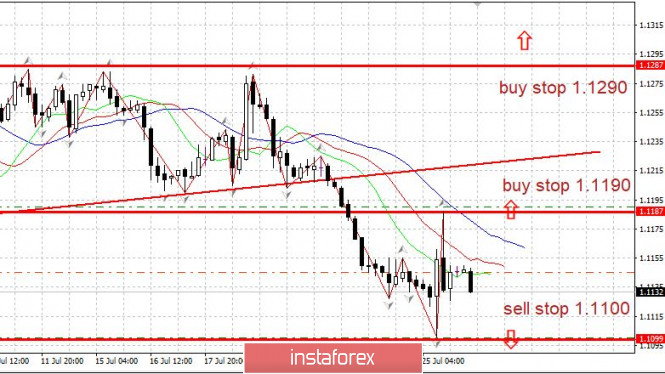
Skepticism in the market added a forecast of economists of the European Central Bank, which lowered the inflation forecasts in the eurozone in the coming years. This revision is not surprising in the current environment, where the economy is once again showing a slowdown, even despite the stability of the labor market. Most likely, during the next meeting of the central bank in September this year, ECB leaders will announce new measures to stimulate the economy. According to today's report, ECB experts have reduced inflation forecasts until the end of 2021. Thus, 52 experts interviewed by the central bank said that they forecast inflation at the level of 1.3% in 2019, and at the level of 1.4% in 2020. In 2021, inflation will decrease even more and will be 1.5%. As for longer-term inflation, it is expected at 1.7%, that is, in any case, it will not reach the target of 2.0% set by the European Central Bank. All this once again indicates how difficult it is for the European regulator to resolve the situation with low inflation, even despite the low and negative interest rates in the eurozone. As for the risks that could further aggravate the situation with inflation, they include a slowdown in the eurozone economy, as well as weak growth rates of global GDP. The situation on foreign markets, which already rolled down in a recession, the manufacturing sector of the eurozone, also has a disinflationary impact. As for the fundamental data that came out today in the morning, we can only note the consumer confidence in France, which, surprisingly, increased in July this year. According to the statistics agency, the consumer confidence index in France in July this year rose to 102 points against 101 points in June, while economists had forecast a decline in the index to 100 points. As for the technical picture of the EURUSD pair, it is still unchanged. The market is still in the balance, but the bears will try to continue the downward trend. This requires a breakthrough of the intermediate support of 1.1125, which will push the trading instrument even lower in the area of the monthly lows of 1.1100 and 1.1040. If buyers of risky assets try to return to the market, then an intermediate area of 1.1155 will act as resistance, but a larger level is seen in the area of 1.1185. The material has been provided by InstaForex Company - www.instaforex.com |
| The US GDP report provided strong support to the dollar Posted: 26 Jul 2019 07:46 AM PDT
US: Economic growth slowed less than expected in the second quarter, and consumer spending eased the decline in exports. In general, the data ease concerns about the state of the leading world economy. However, a rather optimistic report of the US Department of Commerce will not stop the Fed rate cut, given the growing economic risks, especially from the trade war between the US and China. Despite higher than expected GDP figures, business investment declined for the first time in more than three years, and housing for the sixth consecutive quarter. The head of the Fed Jerome Powell earlier this month called investment in business and housing weak spots in the economy. But high consumer spending and a strong labor market will not reduce the rate of 50 basis points at once and may raise doubts about a further easing of monetary policy this year. The government reported that GDP grew by 2.1% year-on-year in the second quarter. The GDP report showed weaker inflation growth in the last quarter, although the trend remains favorable. The inflation indicator monitored by the Fed rose by 1.8% last quarter, slightly below the US Central Bank's target of 2%. Inflation rose by 1.5% compared to the second quarter of 2018. After the data, the dollar continued to rise against a basket of major currencies, while US Treasury bond prices fell, as did US stock index futures. Consumer spending, which accounts for more than two-thirds of US economic activity, grew by 4.3% in the second quarter, the best result since the fourth quarter of 2017. The increase in spending is supported by the lowest unemployment rate in the last 50 years. The material has been provided by InstaForex Company - www.instaforex.com |
| The dollar wiped its nose to all skeptics Posted: 26 Jul 2019 07:10 AM PDT Too much bad news. So, you can call the results of the week to July 26 for the single European currency. The decline in business activity in the German manufacturing sector to the lowest level in the last seven years, the IMF's decline in forecasts of global GDP growth to 3.2%, an increase in the probability of a disorderly Brexit, Mario Draghi's hints at lowering the deposit rate and restarting QE. What could be worse for EUR/USD bulls? When US GDP at the end of the five-day period pleased traders, it became clear that the attempts of fans of the euro to counterattack, most likely, doomed to failure. The US dollar may be weak, but it is not so weak as to retreat before weakened macroeconomic statistics, political risks, and the ECB's intentions to follow the path of monetary expansion. The link between global GDP and German exports is very strong. The slower the global economy grows, the worse Germany gets. It is not surprising if the share of deliveries abroad from this country is 47% of the gross domestic product. In this regard, an increase of 3.2% compared to +3.6% in 2018 and + 3.8% in 2017 causes irreparable damage to the Germans. According to BloombergEconomics, global GDP will slow to 2.6% in the second quarter. Mario Draghi did not find it difficult to implement his ideas to weaken monetary policy, as the main opponents, "hawks", are tied with Germany. If its economy feels unimportant, even such an ardent opponent QE as the President of the Bundesbank, Jens Weidmann, becomes meek as a lamb. The head of the ECB said that the deposit rate will be at -0.4% or lower, and the central bank will begin to consider the content and scope of QE. Previously, the words "or lower" was not possible, so the signal of a weakening of monetary policy sounded in September. European debt bonds responded by falling yields, and in Germany and in Greece – to historically low levels. At the same time, the cost of borrowing decreased, and the euro finally took away from the yen the status of the main funding currency. The cost of carry-trade in the regional currency is now lower than that of the "Japanese". Dynamics of the value of Japanese and European borrowings
What can it do? For example, if the Fed does not aggressively weaken monetary policy, the correction of US stock indices will lead to the closure of positions by players on the difference. The euro from the rollback of the S&P500 is likely to suffer more than the yen. The key events of the week by August 2 will be the FOMC meeting and the release of US labor market data for July. After strong US GDP statistics (2.1% growth with forecasts of +1.8% q/q), the derivatives market reduced the probability of federal funds rate cuts by 50 basis points in July to 19%. The Fed can afford not to use monetary expansion at all, which together with strong employment will make the dollar a favorite on Forex. However, in this scenario, the wrath of the President of the United States will be terrible. Technically, the exit of EUR/USD limits of the diamond is a bad sign for the "bulls". They try to counterattack from the level of 88.6% and 113% of the XC pattern "Shark" wave, however, the chances of success are not yet impressive. The material has been provided by InstaForex Company - www.instaforex.com |
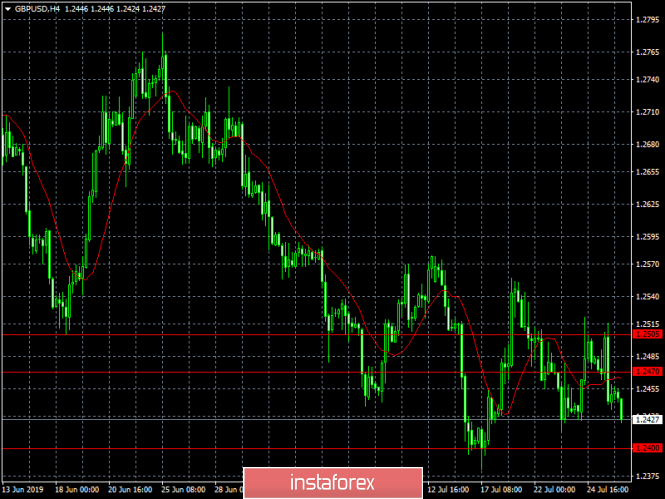
| Posted: 26 Jul 2019 07:10 AM PDT To open long positions on GBP/USD, you need: Buyers are trying to form a false breakdown at the low of 1.2418, forming temporary support around 1.2410. While trading will be above this level, you can expect an upward correction in the resistance area of 1.2456, where I recommend taking the profit. However, given the situation with Brexit and the uncertainty that only grew after the victory of Boris Johnson, the growth of the GBP/USD pair is unlikely to be protracted. The support breakout of 1.2415 in the second half of the day will lead to new lows of 1.2383 and 1.2342, from which you can buy the pound immediately on the rebound. To open short positions on GBP/USD, you need: Bears took advantage of good data on US GDP growth, which was better than economists' forecasts, but to form a more powerful downward momentum is not yet possible. The repeated support test of 1.2415 will still force the bulls to leave the market and retreat to the lows of 1.2383 and 1.2342, where I recommend taking the profits on short positions. In the case of GBP/USD growth in the second half of the day, you can sell immediately on the rebound from the resistance of 1.2456. Given the lack of important fundamental statistics at the end of the week, volatility will remain extremely low, but on the side of the pound sellers. Indicator signals: Moving Averages Trading is below 30 and 50 moving averages, which indicates a further decline in the pair. Bollinger Bands In the case of an upward correction, the upper limit of the indicator in the area of 1.2460 will act as a resistance.
Description of indicators
 |
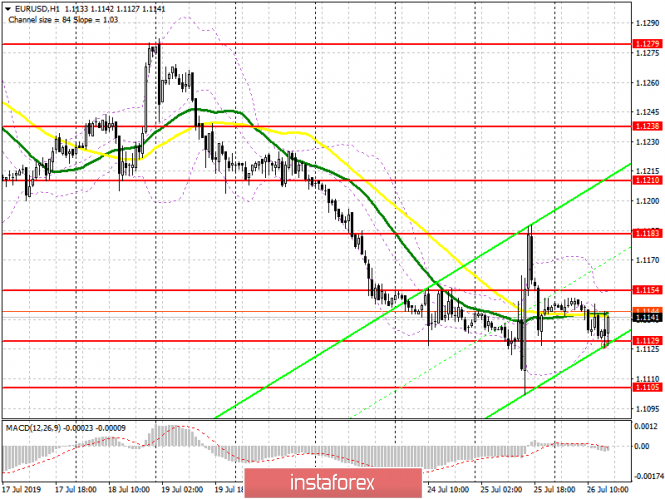
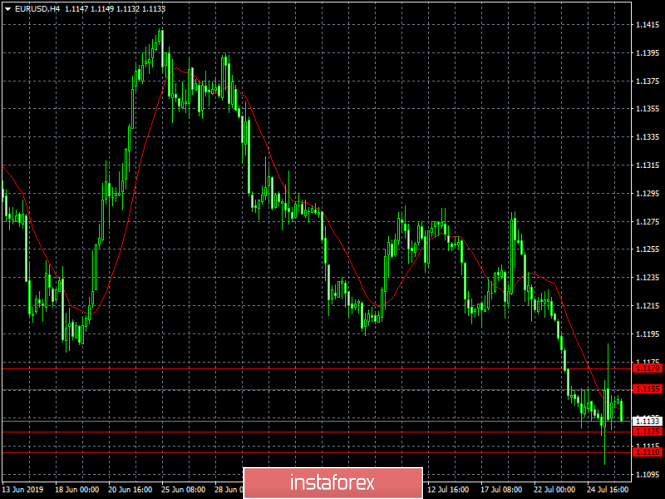
| Posted: 26 Jul 2019 07:10 AM PDT To open long positions on EURUSD, you need: On the one hand, the US GDP report was better than economists' forecasts, and, on the other hand, pointed to a slowdown in the growth of the American economy in the 2nd quarter compared to the 1st, which put traders in a deadlock at the end of the week. At the moment, trading is conducted on the same side channel as in the morning. The breakout of the level of 1.1154 will be a signal to open long positions in the euro in order to continue the upward correction to the area of 1.1183 and to reach a new maximum of 1.1210, where I recommend taking the profit. In the meantime, the bulls managed to hold the pair above the support of 1.129, which retains a chance to continue yesterday's growth. While the decline in EUR/USD in the second half of the day, to the area of 1.1129 again, it is best to open long positions from there when forming a false breakdown. When breaking this range, it is best to buy the euro on a rebound at this week's low of 1.1105. To open short positions on EURUSD, you need: Bears will expect a further decline in the support area of 1.1129 and its breakthrough, as the consolidation below this level will give a new impetus to the downward trend, which will lead to new lows in the area of 1.1105 and 1.1079, where I recommend taking the profits. The formation of a false breakout in the resistance area of 1.1154 will also be a signal to open short positions in EUR/USD. In the case of the growth of the euro above the resistance of 1.1154, it is best to return to short positions on the rebound from the high of 1.1183 or from the level of 1.1210. Indicator signals: Moving Averages Trading is conducted in the area of 30 and 50 moving averages, which indicates the lateral nature of the market. Bollinger Bands In the case of an upward correction, the upper limit of the indicator in the area of 1.1154 will act as a resistance.
Description of indicators
 |
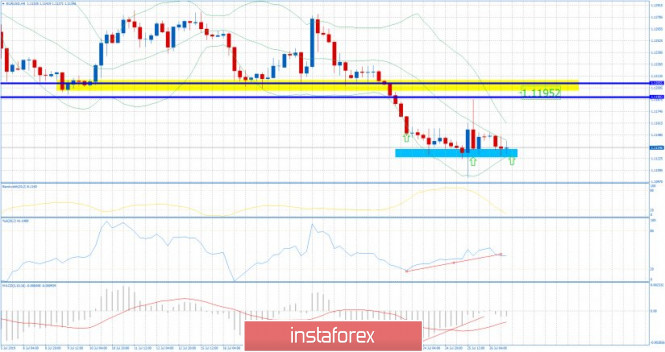
| EUR/USD for July 26,2019 - Support on the test Posted: 26 Jul 2019 06:45 AM PDT Trading recommendation:
EUR did exactly what I expected yesterday. Post EBC move did rally into the our key resistance at the price of 1.1190 and then sold off. EUR is today in consolidation mode but at the support (1.1125). Yellow rectangle – Resistance 1.1195 Red rectangle – Major support 1.1125 MACD oscillator got the bullish divergence in the background and slow line Is going bullish, which is sign that upside is still present. Bollinger bands did narrow by big margin, which is indication of the consolidation before the next breakout. Since the support is on the test, I would watch for buying opportunities. Important resistance is set at the price of 1.1195.Key support level is seen at the price of 1.1100. The material has been provided by InstaForex Company - www.instaforex.com |
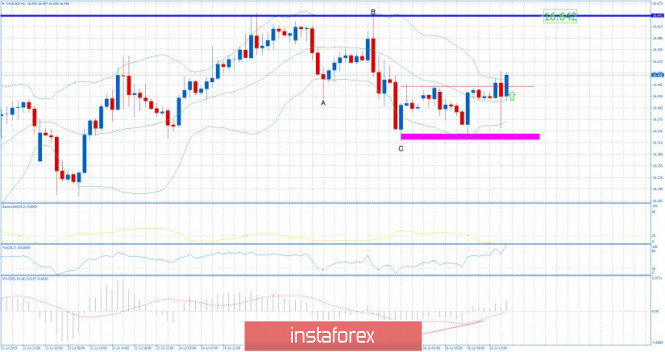
| Silver analysis for 07.26.2019 - New up move is on the way Posted: 26 Jul 2019 06:25 AM PDT Trading recommendation:
Silver is in the strong upward trend on the mid-term and it is good to watch for buying opportunities. We got consolidation for few days and Silver is in my opinion ready for new pushing higher. Watch for buying opportunities. Pink rectangle – Support cluster ($16.32) Red horizontal line – Broken resistance ($16.46) Blue horizontal line – Upward target and resistance ($16.64) MACD oscillator is in positive territory above the zero and the slow line is rising, which is sign that upward movement present. There is also completion of the U-turn or failed test of the support in the background, which is another huge sign that upward movement is on the way. Additionally, I found breakout of the upper band and this great confirmation for bullish movement. Key resistance is set at the price of $16.64., The material has been provided by InstaForex Company - www.instaforex.com |
| July 26, 2019 : EUR/USD Intraday technical analysis and trade recommendations. Posted: 26 Jul 2019 06:19 AM PDT
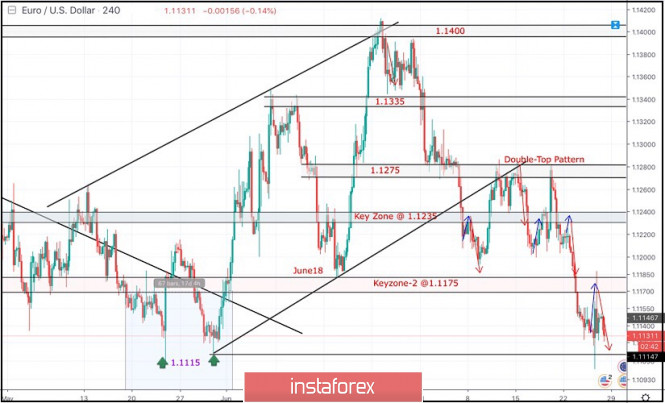
Back in June 24, the EURUSD looked overbought around 1.1400 facing a confluence of supply levels. Thus, a bearish movement was initiated towards 1.1275 followed by a deeper bearish decline towards 1.1235 (the lower limit of the newly-established bullish channel) which failed to provide enough bullish support for the EUR/USD. In the period between 8 - 22 July, sideway consolidation range was established between 1.1200 - 1.1275 until a double-top reversal pattern was demonstrated around the upper limit. Recent Bearish breakdown of the pattern neckline confirmed the short-term trend reversal into bearish towards 1.1175. Fortunately, evident bearish momentum (bearish engulfing H4 candlestick) could bring the EURUSD back below 1.1235 which stands as an Intraday Supply zone to be watched for Intraday SELL entries upon any upcoming bullish pullback. HOWEVER, Early bearish breakdown below 1.1175 facilitated further bearish decline towards 1.1115 (Previous Weekly Low) where evident bullish rejection was recently demonstrated. That's why, Intraday bullish pullback was demonstrated towards 1.1175-1.1200 where a valid SELL entry was suggested in the previous article. It's already running in profits. Today, Bearish persistence below 1.1115 is mandatory to allow further bearish decline. Otherwise, the EUR/USD remains trapped between the depicted zones (1.1115-1.1175 until breakout occurs in either direction). Trade recommendations : For Intraday traders, a valid SELL entry was offered around 1.1175-1.1200. Initial Target level to be located around 1.1115 while Stop Loss should be lowered to 1.1160 to offset the risk. Intraday traders who missed the initial trade, another SELL entry can be taken upon bearish breakdown below 1.1115 with initial bearish target around 1.1075 & 1.1050. The material has been provided by InstaForex Company - www.instaforex.com |
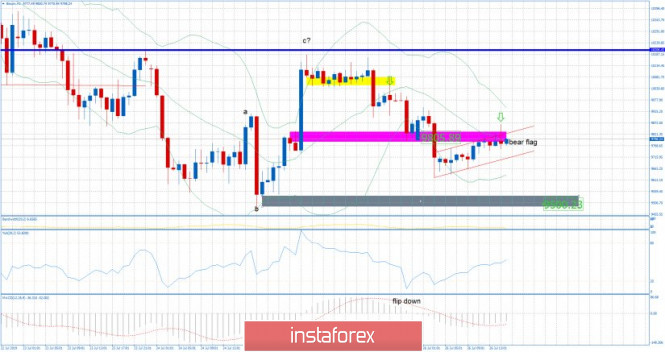
| BTC 07.26.2019 - Downward pressure and bear flag in creation Posted: 26 Jul 2019 06:10 AM PDT Industry news: Soyuzmash, the Union of Machine Builders in Russia, has asked the Central Bank for permission to accept Bitcoin and stablecoin payments for weapons deals. This, they claim, will help them to circumvent US and international sanctions.. . . Trading recommendation:
BTC has been trading exactly what I expected yesterday. The first downward target at the price of $9.805 has been met. BTC traded even lower and tested the level of $9.620 and then it started the bullish correction. In my opinion there is the potential end of the upward correction (bear flag) at $9.800 level. Pink rectangle – Resistance ($9.805) Gray rectangle – Key swing low and downward target ($9.500) Red lines – Upward channel (bear flag) MACD oscillator is in negative territory below the zero, which is sign that downward pressure is still present. Additionally, I found that bear flag is in creation and that breakout of the flag may confirm further downward continuation. The downward target is set at the price of $9.500. Pay attention to the important resistance at the price of $9.850. As long as the BTC is trading below the level of $11.000, I would watch for selling opportunities. The material has been provided by InstaForex Company - www.instaforex.com |
| July 26, 2019 : GBP/USD Intraday technical analysis and trade recommendations. Posted: 26 Jul 2019 05:02 AM PDT
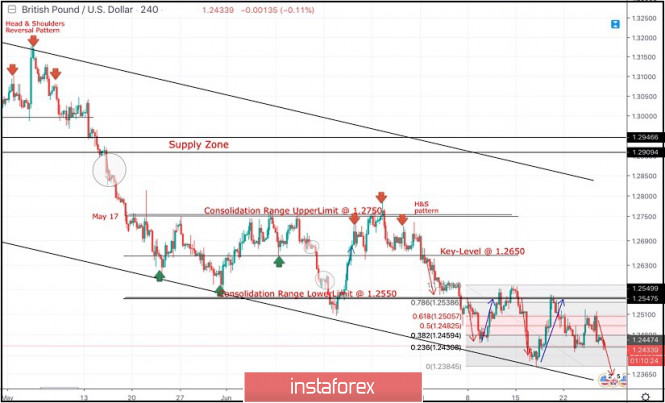
Since May 17, the previous downside movement within the depicted bearish channel came to a pause allowing the recent sideway consolidation range to be established between 1.2750 - 1.2550 with a prominent key-level around 1.2650. Moreover, signs of bearish rejection have been manifested near 1.2750 (Head & Shoulders reversal pattern with neckline located around 1.2650). Intermediate-term technical outlook remains under bearish pressure as long as the market keeps moving below 1.2550 (the lower limit of the depicted consolidation range). In July 18, a recent bullish movement was initiated around 1.2385 (the lower limit of the depicted movement channel). A bullish pullback was demonstrated towards the backside of the broken consolidation range (1.2550) where another valid SELL entry was offered by the end of last week's consolidations. Bearish persistence below 1.2460 (38.2% Fibonacci levels) was mandatory to ensure further bearish decline. However, lack of sufficient bearish momentum was demonstrated around 1.2430 (23.6% Fibonacci Level) allowed the recent bullish pullback to be demonstrated towards 1.2500 (61.8% Fibonacci level) which constituted a prominent Intraday Supply Level where bearish rejection & a valid SELL Entry were suggested Yesterday. Today, Bearish breakdown & persistence below 1.2430 (38.2% Fibonacci Level) are mandatory to allow further bearish decline towards 1.2350 where the lower limit of the depicted movement channel comes to meet the GBP/USD pair. Moreover, Bearish breakdown below 1.2350 is needed to facilitate further bearish decline towards 1.2320 and 1.2270 which correspond to significant key-levels on the Weekly chart. On the other hand, please note that any bullish breakout above 1.2560 invalidates the previously mentioned bearish scenario ( Low probability ). Trade Recommendations: Traders who took the initial bearish trade near 1.2500 should lower S/L to 1.2480 to offset the associated risk. Initial T/P levels to be located around 1.2430 and 1.2360. Intraday traders who missed the initial trade, another SELL entry can be taken upon bearish breakdown below 1.2430 (23.6% Fibonacci Level) with initial bearish target around 1.2350, 1.2320 and 1.2270. The material has been provided by InstaForex Company - www.instaforex.com |
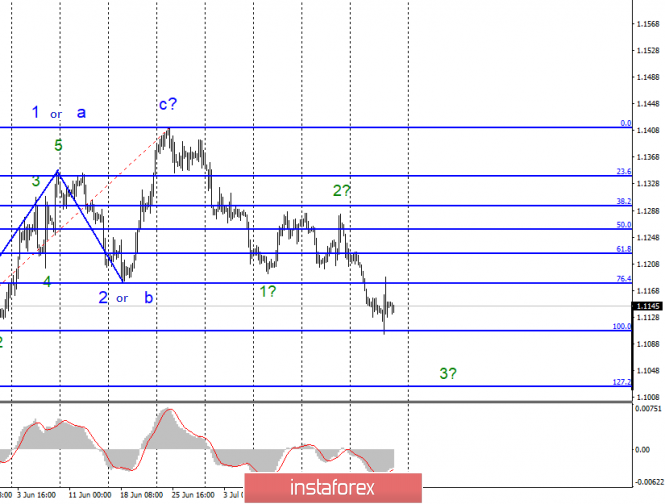
| Wave analysis of EUR / USD and GBP / USD for July 26. US GDP may again please bears in both pairs Posted: 26 Jul 2019 04:18 AM PDT EUR / USD On Thursday, July 25, trading ended for the EUR / USD pair with an increase of 10 basis points, although during the day, the instrument made jerks both up and down by 40 bp. However, at the end of the day, there were no grounds for assuming a change in the current wave pattern. The euro-dollar pair is still prone to decline as part of wave 3. The ECB meeting is over, and today, markets will closely monitor the GDP report for the second quarter of 2019. The value of GDP will not be final, but the current forecast of + 1.8% is already much lower than the previous value of + 3.1%. However, at the same time, the markets will not look at the compliance of the real value with the previous, but at the compliance of the real value with the forecast. Thus, any real numbers above 1.8% will be perceived by the market as a positive factor. The news background is not in favor of the euro, from my point of view, as the ECB took the "pigeon" position, and in the future showed willingness to reduce rates and reanimate the program of quantitative easing. Such a news background perfectly "fits" the current wave marking. Purchase goals: 1.1412 - 0.0% Fibonacci Sales targets: 1.1106 - 100.0% Fibonacci 1.1025 - 127.2% Fibonacci General conclusions and trading recommendations: The euro-dollar pair has moved away from its lows against the background of the ECB meeting and its results. However, the downward mood in the forex market remains. Thus, I recommend selling the pair with targets near the levels of 1.1106 and 1.1025, which equates to 100.0% and 127.2% Fibonacci, when the MACD signal is down. GBP / USD
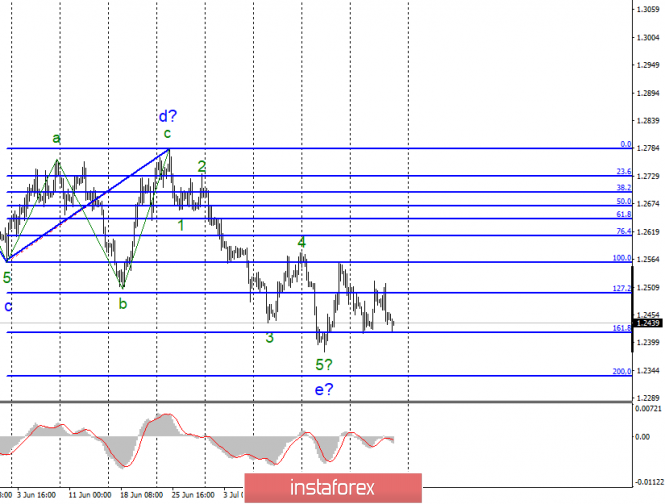
The GBP / USD pair fell on July 25 by 25 basis points, thus preserving the integrity of the current wave counting, involving the construction of at least three upward waves. At the same time, the pound-dollar instrument leaves the current lows very reluctantly, since it does not allow it to make a negative news background. EU officials have reported over the past two days three times that there will be no new negotiations with the new British Prime Minister under the terms of Brexit, that all of Boris Johnson's demands will not be met, and there are no grounds for a new dialogue at all. Moreover, the European Union does not fear Brexit without an agreement and believes that it is London that will suffer much greater losses from such an outcome of a 3-year epic than the EU. Thus, markets can rightly decide that there is no reason to buy a pound, therefore, need to resume sales. It is this factor that can break the current wave marking and lead to its complication. However, much will depend on the decisions of the Fed next week and the rhetoric of Jerome Powell. Sales targets: 1.2334 - 200.0% Fibonacci 1.2194 - 261.8% Fibonacci Purchase goals: 1.2783 - 0.0% Fibonacci General conclusions and trading recommendations: The wave pattern of the pound-dollar instrument implies the completion of the construction of the downward wave e. Thus, I recommend small purchases of a pair with targets located above 1.2550 and with an order restricting losses below the minimum of wave e, with the MACD signal up. I recommend to return to sales no earlier successful attempt to break through the minimum of wave e. The material has been provided by InstaForex Company - www.instaforex.com |
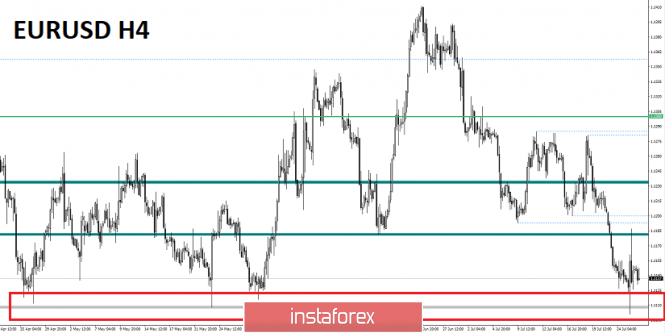
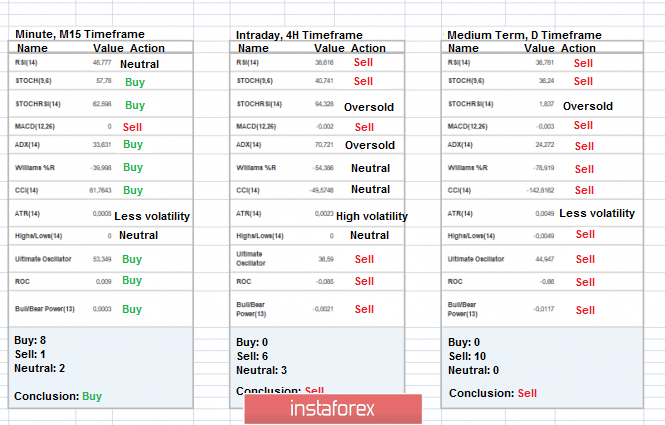
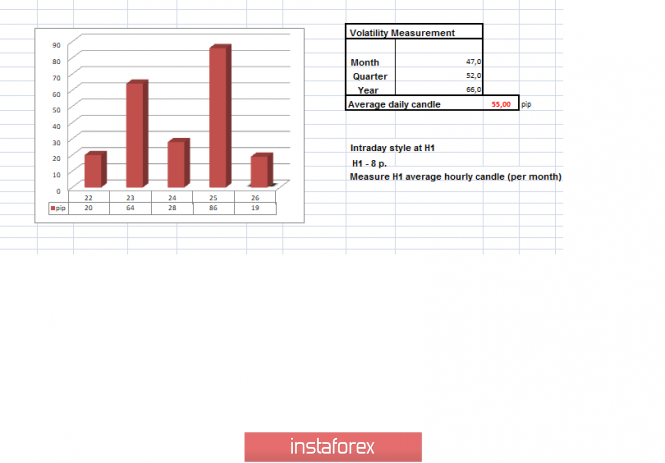
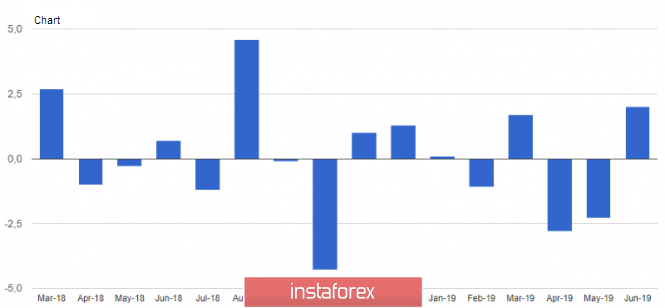
| Trading recommendations for the EURUSD currency pair - prospects for further movement Posted: 26 Jul 2019 04:17 AM PDT For the last trading day, the euro / dollar currency pair showed a high volatility of 86 points, as a result forming a very interesting amplitude of oscillation. From the point of view of technical analysis, we saw the rally as much in both directions, where two coordinates were touched at once: 1,1100 - a key range level, which keeps us from restoring the global downward trend; 1.1180 is a periodic level, which is the point of the regrouping of trading forces. As discussed in a previous review, traders shared two fronts: First, due to the fear of rapprochement with the key level of 1,1100 and the upcoming ECB meeting, they covered all their short positions; Second, more greedy traders continued to hold short positions, but with a smaller trading volume. What is the result? All were in the black, as the downward movement was and the upward movement too, thereby making it possible for everyone to make money. Considering the trading chart in general terms (daily timeframe), we see that the control point in the form of the range level 1,1100 was affected, but not broken, thus it is too early to talk about the resumption of the global downward trend, but thoughts and theory remain. The focus of the news background of the previous day, of course, was the ECB meeting, followed by a press conference. A few days before the event, the media and eminent experts foreshadowed a speedy reduction in the interest rate, scaring everyone, of course. Naturally, on this background, we saw a rapid decline throughout the week. The "X" day has come, it turns out, the ECB head, Mario Draghi, throws up his hands, saying that there will be no show - we are diverging. If, of course, his speech was briefly analyzed, the rate was left at the same level, where Draghi added that the rate cut was not already discussed at the meeting today, we want to see the following forecasts before taking action. If we consider the meeting in general terms, the regulator pointed to the possibility of lowering interest rates. Now, the ECB intends to keep rates at their current or lower levels, And now, we recall the hysteria in the media and my words of yesterday regarding manipulation. Everything falls into place, and someone just earned good money from it. We return to the news background, yes, it was yesterday, although it remained in the background due to the synchronous release with Mario Draghi. Statistics on durable goods orders in the United States were released, where growth was expected, but an even more beautiful picture was obtained. Previous data on reserves was revised and, it turns out, everything was still not so bad when they wrote about -1.3%, in fact they were -2.3%, where the percentage went, is still not clear. The final data came out with a very good increase of 2.0% with a forecast of 0.7%. Obviously, this news is in the piggy bank of the dollar, but I repeat, the news came out synchronously with the press conference of Mario Draghi and thus remained in the background. Finally, according to our old tradition, we end this section with a soap opera called "Brexit". The new British Prime Minister, Boris Johnson, in his first speech in this position in parliament, said that Britain was not yet sufficiently ready to leave the European Union without an agreement, until October 31, the possibility of a Brexit deal remains. Boris Johnson also added that he intends to raise negotiations with the EU regarding the terms of the exit and the trade agreement. In turn, European Commission President Jean-Claude Juncker told the new British Prime Minister that the EU's position on the agreement is unchanged. In his opinion, the exit agreement is the best and only possible deal. Perhaps Boris Johnson missed out on attention, as Juncker over the past six months 10 times outlined the position of the EU, but suddenly, he just forgot, it is better to repeat. Today, in terms of the economic calendar, we have data on GDP (2Q) in the United States, which will certainly interest traders. According to preliminary forecasts, economic growth is expected to slow down from 3.1% to 1.8%. The upcoming trading week begins with an empty economic calendar, but it is already from Wednesday that a weighty layer of events and statistics awaits us, which costs only one Fed meeting with a possible reduction in the key rate. The most interesting events are displayed below ---> Wednesday, July 31 EU 09:00 UTC+00 - Consumer Price Index (CPI) (y / y) (July): Prev. 1.3% ---> Forecast 1.2% United States 15:15 MSK - Change in the number of people employed in the non-farm sector from ADP (July): Prev. 102K ---> 153K forecast United States 18:00 UTC+00 - Fed interest rate decision: Prev. 2.50% ---> Forecast 2.25% United States 18:30 UTC+00 - FOMC Press Conference Thursday, 1 August EU 08:00 UTC+00 - Manufacturing Business Index (PMI) (July) United States 14:00 UTC+00 - Manufacturing PMI from ISM (July): Prev. 51.7 ---> Forecast 52.7 Friday, August 2 EU 09:00 UTC+00 - Producer Price Index (PPI) (y / y) (June): Prev. 1.6% ---> Forecast 1.7% United States 12:30 UTC+00 - Change in the number of people employed in the non-agricultural sector (July): Prev. 224K ---> 160K forecast United States 12:30 UTC+00 - Unemployment rate (July): Prev. 3.7% ---> Forecast 3.6% These are preliminary and subject to change. Further development Analyzing the current trading schedule, we see that after a kind of rally, the quotation went into the accumulation stage, fluctuating within 1.1130 / 1.1155. Traders are waiting because there are many nuances, all early positions are already closed. The first alignment, which is seen, is to wait, the accumulation in any case will lead to a sharper movement, and now you can relax and stretch from orders. Of course, we do not forget about the upcoming statistics in the form of data on US GDP and the upcoming week, where they plan to lower the key rate, and how painful it did not sound to sellers, there are prerequisites for a weaker dollar, and rather are small ones. Based on the available information, it is possible to decompose a number of variations, let's consider: - We consider buying positions in the case of a fix higher than 1.1160. The first perspective is 1.1180, where in the case of a fixation above this value, we can already speak about the progress towards 1.1230-1.1270, but we'll talk about this next week. - Items for sale, here is not so simple. There is a risk in the form of informational news background, so we wait and analyze for a start a clear fixation lower than 1,1100. Indicator Analysis Analyzing a different sector of timeframes (TF), we see that indicators in the short term are variably set to climb, but we are still in a cluster, therefore indicators of change. Intraday and mid-term prospects both retain a descending interest against the general background of the market. Weekly volatility / Measurement of volatility: Month; Quarter; Year Measurement of volatility reflects the average daily fluctuation, based on monthly / quarterly / year. (July 26 was based on the time of publication of the article) The current time volatility is 19 points. It is likely to assume that due to the accumulation there is still a chance of a surge and thereby an increase in volatility, let's see what will happen at the time of the publication of data on the USA. Key levels Zones of resistance: 1.1180 *; 1,1300 **; 1.1450; 1.1550; 1.1650 *; 1.1720 **; 1.1850 **; 1.2100 Support areas: 1,1100 **; 1.1000 ***; 1,0850 ** * Periodic level ** Range Level *** Psychological level **** Article is based on the principle of conducting a transaction, with daily adjustment. The material has been provided by InstaForex Company - www.instaforex.com |
| Posted: 26 Jul 2019 04:13 AM PDT As a result of the next meeting of the European Central Bank (ECB), the EUR/USD pair first rushed to two-year lows, then somewhat recovered. But eventually, it returned to its original position. This time, the European Central Bank decided not to lower the basic rates. However, in the accompanying statement of the regulator said that until the end of the first half of 2020, he intends to keep them at current or lower levels. Market participants perceived this as a transparent hint that the deposit rate would fall from the current -0.40% to -0.5% in September. Also, the financial institution made it clear that additional measures could be introduced to stimulate the eurozone economy. In particular, it was reported that the central bank committees have already been instructed to study options on the composition and volume of the asset purchase program. On such statements, the euro came under sales pressure. The rate of the single European currency fell by 0.6% and for the first time since May 2017, it was close to the level of $ 1.11. According to experts, the results of the July meeting of the Governing Council of the ECB indicate that super-soft monetary policy seems to have settled in the eurozone seriously and for a long time. "The prospect of leaving the deposit rate deeper into negative territory at the September meeting and weaker than the US, the prospects for economic growth in Europe reduce the attractiveness of investing in European assets, which affects the euro rate," said Nordea Bank experts. "Now it's more and more likely that at the September meeting the ECB will not resort to anyone measure, but will accept a package of several measures," said economists at ING. During the press conference, the head of the ECB, Mario Draghi, tried to smooth out the first keen impressions of investors on the possible launch of the new QE program. He said that the proposals are of a variable nature. They must be considered, examined, and then approved by the ECB Board. He also noted that at the last meeting that there were no discussions on reducing rates, QE limits, and 2% change inflation target. Against this background, the single European currency managed to win back part of the losses against the US dollar. These are the purchases of the euro began on the facts since the ECB refrained from immediate action. At the moment, the EUR/USD pair rebounded to the level of 1.1190 but then rolled back to previous positions. Apparently, the market was waiting for clearer signals from the ECB, and therefore the movement of quotations turned out to be somewhat contradictory. In addition, substantial uncertainty remains on key issues for the European economy such as trade wars, the risk of increasing US duties on European cars, Brexit, and Italy's attempts to move to a more "soft" budget policy. It appears that the players also did not dare to go beyond the established range, since they preferred to wait for the Fed's comments and recent statistics on the American economy, including the first estimate of GDP and data on the country's labor market. Now the attention of investors switches to the Fed meeting, which will be held on July 31. The main question now is how decisive the FOMC will be. Over the past week, greenbacks strengthened due to the fact that the market was losing hope of reducing the interest rate in the United States by 50 basis points in July. On the one hand, the Fed can not rush to adjust the cost of borrowing, given the historically low unemployment rate, as well as the US GDP growth above average and acceptable (although not optimal) inflation rate. On the other hand, the dovish rhetoric of the ECB allows the Fed to respond adequately. Moreover, not so long ago, US President Donald Trump reproached the American Central Bank for silently looking at the competitive devaluations of the euro and the yuan. What reason is there not to correct? According to analysts, a more aggressive than expected reduction in the Fed rate could trigger a "bearish" game against the dollar. The material has been provided by InstaForex Company - www.instaforex.com |
| Posted: 26 Jul 2019 03:45 AM PDT
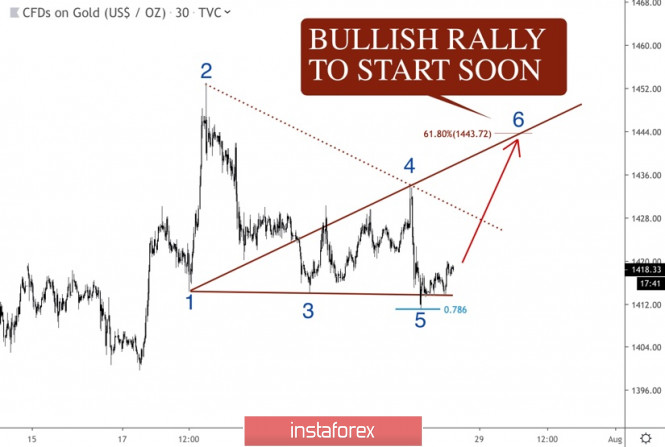
There's a finished bullish Wolfe Wave pattern in Gold. The 0.786 retracement level from the last upward price movement has acted as support, which brings more evidence that wave 5 is in place. Besides, there's a pullback from line 1-3, which highlights the opportunity to have a sixth-wave rally in the coming hours. The break-out of line 2-4 will confirm the bullish outlook. The main target for wave 6 is the 0.618 multiple of the last advance at 1443.72, which is near line 2-4. The subsequent pullback from this level might be a starting point for a downward bearish correction or even for the uptrend reversal. However, if the market breaks the line 2-4 and 0.618 level, there'll be a green light for the further bullish rally. If this happens, the high of wave 2 is likely to be broken. The bottom line is there's a local bullish moment on Gold. The main critical level is line 1-3-5, which is acting as support. If the price breaks and fixates under this line, the outlook will be under pressure. The material has been provided by InstaForex Company - www.instaforex.com |
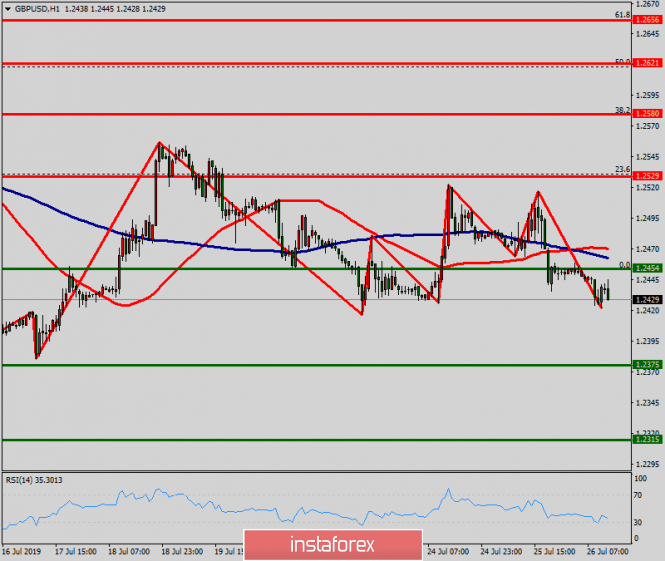
| Technical analysis of GBP/USD for July 26, 2019 Posted: 26 Jul 2019 03:36 AM PDT The GBP/USD pair continues to move downwards from the level of 1.2580. This week, the pair dropped from the level of 1.2580 to the bottom around 1.2454. But the pair rebounded from the bottom of 1.2454 then closed at 1.2560. Today, the first support level is seen at 1.2454, the price is moving in a bearish channel now. Furthermore, the price has been set below the strong resistance at the level of 1.2529, which coincides with the 23.6% Fibonacci retracement level. This resistance has been rejected several times confirming the veracity of a downtrend. Additionally, the RSI starts signaling a downward trend. As a result, if the NZD/USD pair is able to break out the first support at 1.2454, the market will decline further to 1.2375 in order to test the weekly support 2. Consequently, the market is likely to show signs of a bearish trend. So, it will be good to sell below the level of 1.2454 with the first target at 1.2375 and further to 1.2315. However, stop loss is to be placed above the level of 1.2580. The material has been provided by InstaForex Company - www.instaforex.com |
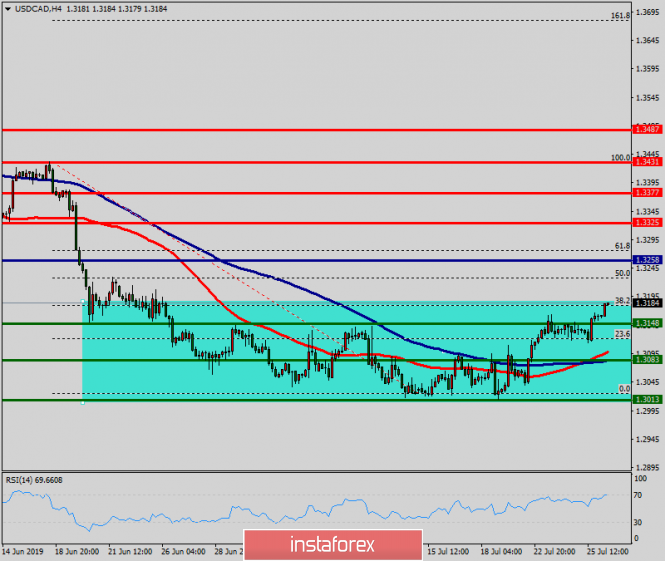
| Technical analysis of USD/CAD for July 26, 2019 Posted: 26 Jul 2019 03:30 AM PDT Overview: The USD/CAD pair continues to move downwards from the level of 1.3258. This week, the pair dropped from the level of 1.3258 (this level of 0.9965 coincides with the double top) to the bottom around 1.3148. Today, the first resistance level is seen at 1.3258 followed by 1.3325, while daily support 1 is found at 1.3148. Also, the level of 1.3258 represents a weekly pivot point for that it is acting as major resistance/support this week. Amid the previous events, the pair is still in a downtrend, because the USD/CAD pair is trading in a bearish trend from the new resistance line of 1.3258 towards the first support level at 1.3038 in order to test it. If the pair succeeds to pass through the level of 1.3038, the market will indicate a bearish opportunity below the level of 1.3038 in order to continue towards the point of 1.3013. However, if a breakout happens at the resistance level of 1.3325, then this scenario may be invalidated. The material has been provided by InstaForex Company - www.instaforex.com |
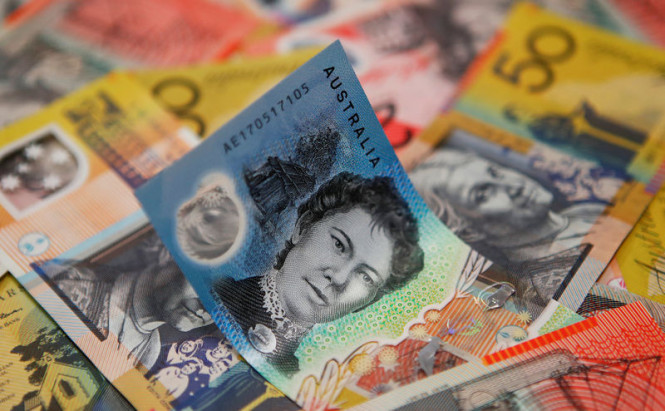
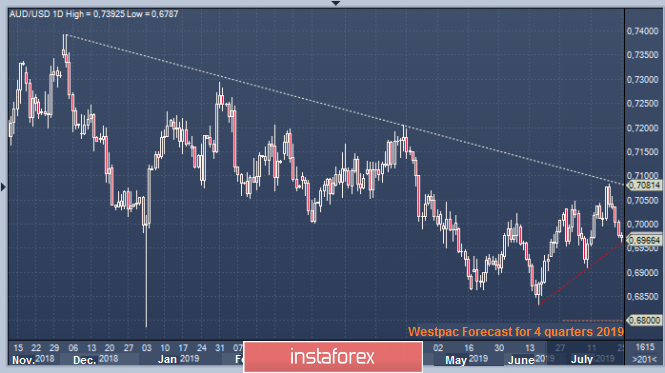
| Australian dollar forecast decline Posted: 26 Jul 2019 03:18 AM PDT According to the calculations of currency experts at Westpac, the Australian currency does not expect anything good in the near future. According to analysts, the results of the recent meeting of the Reserve Bank of Australia (RBA) had a negative impact on the dynamics of the national currency. Recall, on Thursday, July 25, a meeting of the regulator was held, at which Philip Low, the head of the RBA, declared his readiness to further ease monetary policy. This is possible if an earlier reduction in the key rate fails to push the country's economy to growth. At present, experts are fixing the tendencies to the deterioration of the situation in the economy of the Green Continent. If unemployment and inflation do not improve by October of this year, the regulator will have to change the strategy. Westpac believes that the reduction in rates in Australia will be faster than expected. Since the beginning of 2019, the Australian dollar has declined moderately over the past seven months. Maximum cost AUD in 2019 was fixed in the middle of January, and the minimum - at the end of last month. The price of the Australian dollar has changed the most in June, and the weakest of all - in July. Most of all, AUD lost in March of this year, according to the results of which its price decreased by 2.5%. Currently, the currency of the Green Continent holds its position above the support line with June lows within 0.6960. Many experts see this as a chance for new attempts at recovery, but Westpac doubts the abilities of the Australian dollar. The bank believes that the AUD / USD pair expects to roll back to multi-year lows. A drop of honey in a barrel of tar will be a reduction in the Fed's rates, which will slightly support the Australian currency. According to further forecasts by Westpac analysts, in the third and fourth quarters of 2019, the AUD rate will remain at 0.68, and in the first and second quarters of 2020 - at 0.66.  |
| EUR/USD: bears to push price even lower soon Posted: 26 Jul 2019 03:08 AM PDT
4/8 Murrey Math Level acted as support yesterday, but bulls haven't fixated above 6/8 MM Level. The market is consolidating below Super Trend Lines, which brings more evidence that the bearish trend isn't losing its steam. However, the pair is likely to test 6/8 MM Level once again before we see the price lower. Another pullback from 6/8 MM Level will confirm the outlook and might be a starting point for the next phase of a decline. Besides, Super Trend Lines remains under the 'Bearish Cross', which highlights the opportunity for the pair to sink even lower. The next important target is 2/8 MM Level, which is confirmed by higher timeframes. The subsequent pullback from this level might be a departure point for a local upward correction. Another thing, it's essential for the market to fixate under 3/8 MM Level just to confirm the scenario. Meanwhile, if the price breaks 6/8 MM Level and takes hold above it, the bearish outlook will be at risk. If this happens, we should wait until the pair returns under the Super Trend Lines as a signal that bears are returning into the market. 4/8 MM Level might act as support once again, so it's possible to have a local bullish correction form this line. The bottom line is that EUR/USD remains bearish and yesterday's rocking hasn't changed the outlook. The question is when the current correction ends, but the odds are to see the pair even lower in the near future. The material has been provided by InstaForex Company - www.instaforex.com |
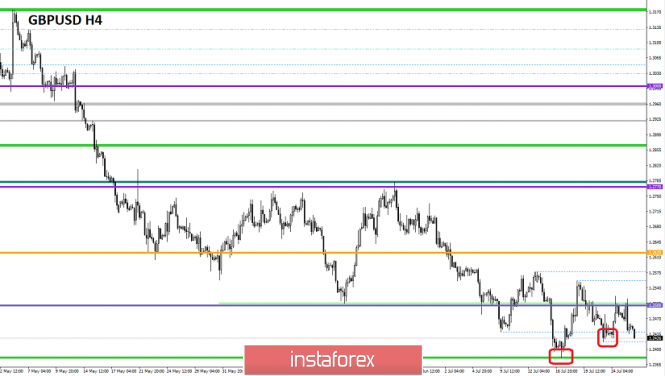
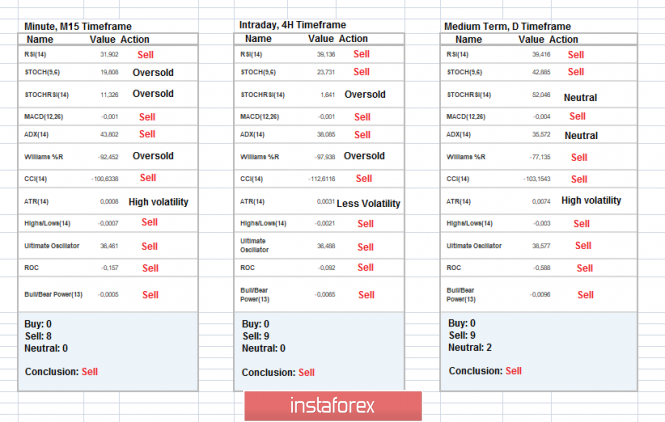
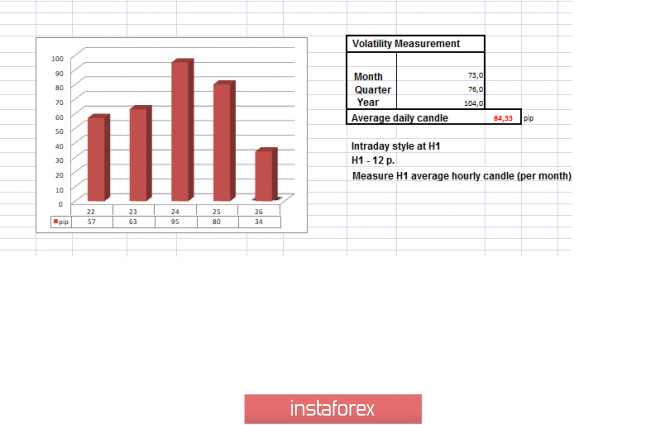
| Trading recommendations for the GBPUSD currency pair - prospects for further movement Posted: 26 Jul 2019 02:13 AM PDT Over the previous trading day, the pound / dollar currency pair showed a volatility equal to the average daily of 80 points, as a result of having an attempt to restore the original movement. From the point of view of technical analysis, we see that the periodic level of 1.2500 played the role of resistance, restoring bearish interest in the market. As discussed in the previous review, traders were divided into several factions: The first attributed themselves to the obvious bears and held downward positions from July 19-22. The latter were insured and covered their previously open sell positions at the time of the rebound on July 24, but they still retained a downward interest. So yesterday, they were actively looking at points to restore short positions; the third faction closed down positions by zero and took a waiting position. Considering the trading chart in general terms (daily timeframe), we see that the theory for the "Correction" tact has not yet arrived and that the "Impulse" tact in global terms is still valid. It has been justified and there is a prerequisite for updating the minimum. The news background of the past day contained statistical data on the volume of orders for durable goods in the United States, where they expected an increase, but not such a development. To begin with, the previous data on stocks were, to put it mildly, not very much, -1.3%, but they were revised, and it turns out that everything was much worse, -2.3%. In fact, the data came out very positive, an increase of 2.0%, and, of course, against this background, the dollar went to strengthen. Yesterday, there was an ECB meeting at the center of the event, where the rate was left unchanged, which is normal in principle, but before this event, several publications were respected for several days in a row and experts persistently pushed through the topic of lowering the rate, as if preparing for the gulf of their deals. Of course, after the speech of the ECB Head Mario Draghi and the final arrangement of all points over all the discussions, the euro did not start a childish storm, and the pound, in turn, continued to wobble on its own wave. What is the reason for the lack of correlation between pairs? We begin with the fact that there is a correlation as such, but not in the current period of time. The pound is experiencing big problems, and with the current appointment of a new prime minister, there is a distinct stupor, fear and ambiguity, and for this reason, the steps are rather awkward. Kohl started talking about a new prime minister, then a few words about his first speech in this position in the parliament. Boris Johnson believes that Britain is still not sufficiently ready to leave the European Union without concluding an agreement, until October 31 wherein the possibility of a Brexit deal remains. Boris also added that it intends to boost negotiations with Europe regarding the terms of the exit and trade agreement. After such statements, an arbitrary smile arises, about which revision of the deal is meant, if so many times our favorite European Commission head Jean-Claude Juncker explained to his colleagues that there will be no revision. And by the way, Jean-Claude Juncker did not keep himself waiting, and promptly duplicated his previously designated conditions to the new prime minister. "Juncker confirmed that the EU's position on this is unchanged. In his opinion, the exit agreement is the best and only possible deal. " Today, in terms of the economic calendar, we have data on GDP (2Q) in the United States, which will certainly interest traders. According to preliminary forecasts, economic growth is expected to slow down from 3.1% to 1.8%. The upcoming trading week in terms of the economic calendar begins sluggish and boring, but from the environment of "Heavy Metal". The Fed meeting with a possible reduction in the key rate, given by the ADP with the subsequent non-farm outcome, will also have a meeting with the Bank of England, but it is unlikely that there will be something super-ordinary. The most interesting events were displayed below ---> Wednesday, June 19 United States 12:15 UTC+00 - Change in the number of people employed in the non-farm sector from ADP (July): Prev. 102K ---> 153K forecast United States 18:00 UTC+00 - Fed interest rate decision: Prev. 2.50% ---> Forecast 2.25% United States 18:30 UTC+00 - FOMC Press Conference Thursday, June 20 United Kingdom 08:30 UTC+00 - Manufacturing Business Index (PMI) (July): Prev. 48.0 ---> Forecast 49.2 Bank of England meeting followed by a press conference United States 14:00 UTC+00 - Manufacturing PMI from ISM (July): Prev. 51.7 ---> Forecast 52.7 Friday, June 21 United Kingdom 08:30 UTC+00 - Index of business activity in the construction sector (July): Prev. 43.1 United States 12:30 UTC+00 - Change in the number of people employed in the non-agricultural sector (July): Prev. 224K ---> 160K forecast United States 12:30 UTC+00 - Unemployment rate (July): Prev. 3.7% ---> Forecast 3.6% These are preliminary and subject to change. Further development Analyzing the current trading chart, we see that the pound is still seeking to update new lows, storming the 1.2430 mark, which previously held us. Traders, in turn, held downward positions with the hope of a move to 1.2381, but they will actively talk about this after the breakdown of the 1.2417 mark (July 23). It is likely to assume that in the case of overcoming the value of 1.2417, we will move towards 1.2381, but we should not forget about the statistics from the United States, which may contain a strong fall. Based on the available information, it is possible to decompose a number of variations, let's specify them: - We consider buying positions in two variations: the first, in the case of another deceleration within 1.2420 / 1.2430, with another refinement; the second option, already in the case of support in the range of 1.2380. In any case, there must be a confirmation of a rebound. - If we do not have sell positions, then the point is considered to be around 1.2417, with the primary move to 1.2381. Indicator Analysis Analyzing a different sector of timeframes (TF), we see that indicators in the short, intraday and medium term perspective are fixated on a downward trend, which is quite justified against the general background of the market. Weekly volatility / Measurement of volatility: Month; Quarter; Year Measurement of volatility reflects the average daily fluctuation, based on monthly / quarterly / year. (July 26 was based on the time of publication of the article) The current time volatility is 34 points. It is likely to assume that the volatility will be limited to the daily average and the current framework in the form of price values. Key levels Zones of resistance: 1.2430; 1.2500; 1.2620; 1.2770 **; 1.2880 (1.2865-1.2880) *; 1.2920 * 1.3000 **; 1.3180 *; 1,3300. Support areas: 1.2381 *; 1.2350 **; 1.2100 **; 1.2000. * Periodic level ** Range Level *** The article is based on the principle of conducting a transaction, with daily adjustment The material has been provided by InstaForex Company - www.instaforex.com |
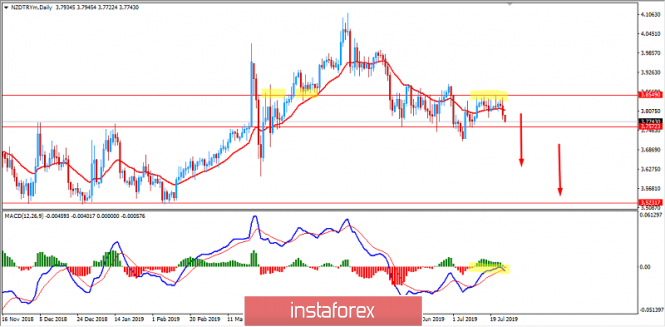
| Analysis of NZD/TRY for July 26, 2019: bearish trend to continue Posted: 26 Jul 2019 02:11 AM PDT NZD/TRY has been quite impulsive with the recent bearish momentum while residing inside the corrective range between 3.7570 and 3.8550 area. Turkey has certain rate cut bias, so TRY managed to gain momentum over NZD which is expected to extend further as the market sentiment shifts. New Zealand reported a better-than-expected trade surplus for June, but it came on the back of a fall in imports as exports decreased suddenly. This is a fresh sign that global trade is contracting. The New Zealand Dollar/ Turkish Lira has shown a correction from the last few weeks. The New Zealand Trade Balance for June was reported at 365M monthly and at -4,937M 12-month year-to-date where the predictions were a figure of 100M and of -5,105M. Investors can compare this to the New Zealand Trade Balance for May which was reported at -264M monthly and at -5,492M 12-month year-to-date. Exports for June were reported at 5.01B and imports came in at at 4.65B. RBNZ also indicated further easing in August and pointed out that the risks related to trading activity have been strengthened but the downside risks remained unchanged to the employment and inflation outlook. The RBNZ is expected to converge with the RBA over time, depending on the incoming data. On the other hand, the Central Bank of Turkey declared a policy easing by cutting the policy rate by 425bp to 19.75% vs market consensus of 250bp at its July rate-setting meeting. With the decision, the ex-post real policy rate that had been low or sometimes even negative since the global crisis dropped sharply to 400bp from more than 800bp before vs the average ex-post policy rate for EM peers around 300-400bp. The bank explained on the recently released data and provided opportunities for the near term. On the inflation front, it recognized the ongoing downtrend on the back of a deceleration in unprocessed food and energy prices, along with a contribution from domestic demand and the tight monetary policy. The inflation report will be released next week showing the evidence of inflation forecast where the current expectation is slightly the projections of the April. The year-over-year increase in consumer prices peaked last October near 25.25%. In June it stood at 15.72%. Before the weekend, the central bank's survey of inflation expectations over the next 12 months fell to 13.90% from nearly 16.5% at the end of last year. As of the current scenario, despite the positive trade balance report, NZD could not manage to attract market sentiment over TRY which indicates the strength TRY have over NZD. Ahead of the ANZ business confidence from New Zealand along with the Turkish trade balance, the New Zealand Dollar/ Turkish Lira is expected to continue the bearish pressure where the ultimate target will be at 3.50. TECHNICAL OVERVIEW: The price is currently pushing lower with an impulsive bearish pressure after rejecting off the corrective range resistance of 3.8550 area while MACD moving averages also crossed rejecting the resistance of 0.00 level. The preceding trend was bearish and after such consolidation, the price is expected to push lower as it remains below 3.8550 area with a daily close. The price having no Bullish Divergence to oppose the current bearish momentum is expected to lead to further downward pressure in the coming days which may lead the price lower towards 3.50 support area.
 |
| Funny jumps on the spot (a review of EUR / USD and GBP / USD as of 07.26.2019) Posted: 26 Jul 2019 01:44 AM PDT The results of the meeting of the European Central Bank and the subsequent press conference of Mario Draghi did not exactly disappoint. Watching the funny jumps from side to side was extremely interesting. Particularly pleased with the result of all this fun, as they stopped exactly where they started. Events developed strictly according to a given scenario. Shortly before the announcement of the outcome of the meeting, the single European currency was confidently going down, as if preparing to leap up. The reason, of course, was the diligently spreading rumors that the office of Mario Draghi wanted to see the queues of indignant German investors with pitchforks and torches and reduce the deposit rate from -0.4% to -0.5%. That is, they tried to convince us that, according to the European Central Bank, respectable burghers do not pay the banks enough for keeping their savings, and they would be worth more to support German credit institutions suffering from extremely low profits. Meanwhile, other Europeans have no savings, only loans. But as soon as it became known that there were no suicides in the leadership of the European Central Bank, the single European currency predictably flew into the stratosphere. Yet, as they soared to such exorbitant heights, investors suddenly realized that in general, nothing had changed, and quickly returned the single European currency from heaven to Earth. Nevertheless, do not be discouraged, because in September, we are waiting for a repetition of yesterday's performance, since all the prophets now predict that the European Central Bank will lower the rate on deposits at the very beginning of autumn. For the pound, it seems to continue to be in a state of shock due to the fact that the former journalist with a diploma of archeologist has become the new prime minister of Great Britain. And the rhetoric of Boris Johnson with each new day is more and more different from what he said earlier. Speaking yesterday in the House of Commons, the new head of the Conservative Party said that, of course, it is better to leave the European Union with the deal, but if Europe is not ready to make concessions, the United Kingdom will leave it and so. At the same time, Boris Johnson announced the start of new negotiations with Europe on the issue of a divorce agreement. From this news, Jean-Claude Juncker can only ask the Lord why no one hears him, as the head of the European Commission last half or more tirelessly repeats that there will be no more changes to the existing version of the agreement. So if, prior to the election of Boris Johnson, it was clear that on October 31, the UK will leave the European Union under the toughest scenario. Thus, now, several different perspectives emerge which is exactly not clear to anyone. In other words, there is only more uncertainty. Against this background, the pound ignored the results of the meeting of the Board of the European Central Bank and, from the outside, watched merry throwings of the single European currency. Although this allowed it to appreciate American statistics, which showed an increase in the number of orders for durable goods by as much as 2.0% instead of the expected 0.7%. After which, it confidently went down. Today, investors may finally have a reason for the long-awaited correction for the dollar. We are talking about preliminary data on the GDP of the United States for the second quarter, although the forecasts have been revised for the better, it should still show a slowdown in economic growth from 3.1% to 1.8%. Immediately, the oracles of all stripes will begin to shout that this is a foreshadowing of a future recession. The onset of which is predicted next year. In any case, such a sharp slowdown in economic growth will have a negative impact on the dollar. Before the publication of data on the GDP of the United States for the second quarter, the single European currency will wait. After which, it will start to grow in the direction of 1.1175. The pound scenario is similar, and by the end of the day, it is worth waiting for its growth to 1.2500.  |
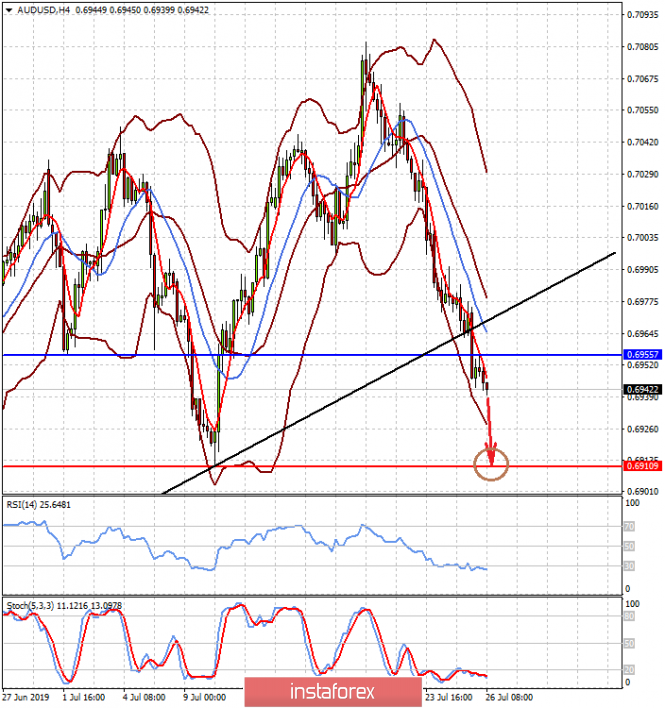
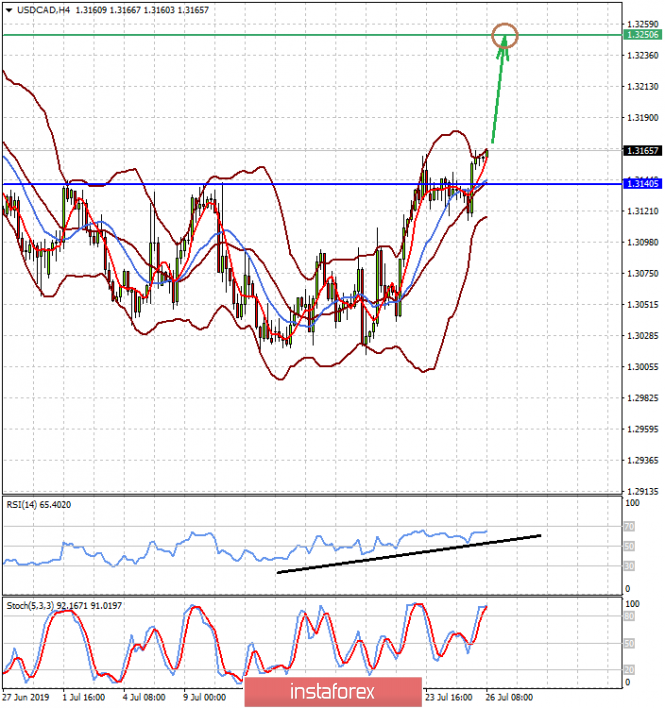
| Posted: 26 Jul 2019 01:42 AM PDT Following the meeting, investors were disappointed, as the expected lowering of interest rates, as well as all sorts of economic mitigation measures, which were repeatedly mentioned in the regulator and were also repeatedly mentioned by the ECB President M. Draghi, have a distant future. Why is this so and not otherwise? If you carefully consider the speech of Draghi, he did not say that the bank is planning full-scale measures to support the economy of the region. Markets were stunned by his phrase that the meeting did not discuss the topic of rate cuts and resulted in the idea of resuming broad incentives. He said that a strong labor market and wage growth supported the economy, but at the same time, there were negative phenomena such as a slowdown in global economic growth and weak international trade. More importantly, he noted that rates would remain at their current level or perhaps even lower, for at least one more year until mid-2020. Investors were shocked. Draghi's words sounded like a bolt from the blue. The single currency, which was at first under pressure, rose sharply and remained not far from the present levels that were before the announcement of the bank's communique after the meeting. On this wave, the main European stock indices, followed by a decline at the US opening. So it still was? And what can we expect in the markets in the near future? In our opinion, this behavior of the ECB can be explained by two reasons. The first is the reluctance of the regulator to inflate financial bubbles with incentive programs, which is combined with the hopes that the trade war between the United States and China, as well as between the United States and Europe, will end or at least somehow settle down. The second reason is the desire to see what the Fed will do and then react somehow. Well, a little more conspiracy. It is possible that the head of the ECB does not want to make any sharp movements until the end of his presidency at the Central Bank, which ends in October of this year. Summing up, we note that the vague position of the ECB will lead to an increase in chaos on European stock markets and the movement of the euro on foreign exchange markets. Well, currently, all the attention of the markets will be drawn to the result of the Fed meeting next week and expected to reduce the key interest rate by 0.25%. Forecast of the day: The AUD/USD pair is trading below the level of 0.6955 in the wake of rising expectations of lowering the interest rate of the RBA. If the price holds below this mark, there is a chance that it will continue to fall to 0.6900-10. The USD/CAD pair broke from the strong resistance level of 1.3140 to the top. Moreover, the vague prospects for the dynamics of crude oil quotations, as well as the continued intrigue around the outcome of the Fed's monetary policy meeting, could lead to further local growth for the pair to 1.3250.  |
| The EU strongly rejected Boris Johnson's claims, Euro and pound are down Posted: 26 Jul 2019 01:27 AM PDT Boris Johnson, the newly appointed prime minister of Britain, turned to the EU with a proposal to provide Britain with additional benefits when leaving the EU. The European Commission President Juncker firmly replied that the proposed conditions for Britain are the best possible. The probability of Britain leaving the EU without an agreement (hard Brexit) has increased to be released on October 31. Euro and pound declined on this news.  |
| Posted: 26 Jul 2019 12:56 AM PDT Traders were very surprised by the speech and statements of the President of the European Central Bank Mario Draghi, who during the press conference made only remote hints at a possible reduction in interest rates and the launch of the asset repurchase program, without giving any temporary guidance when the policy will be changed. On the other hand, it is obvious that the head of the European regulator is gradually preparing the markets for such a scenario, which affects the quotations of risky assets. However, it is already clear that the current euro exchange rate already includes the launch of the bond buyback program and one decrease in interest rates, so global changes in the market are unlikely to occur in the near future. The demand for the US dollar will gradually slow down, as next week all attention will be focused on the meeting of the Federal Reserve System, which, like the ECB, will go to the easing of monetary policy, which will hit the positions of the US dollar. From the speech of the President of the ECB, we can identify several important statements on the subject of monetary policy and inflation. During the press conference, Draghi said that employment growth and wage increases continue to support the economy, but the threat of protectionism and geopolitical factors worsen the mood. In his opinion, the inflationary pressure will remain restrained, as recent data indicated a slightly weaker economic growth in the 2nd and 3rd quarters than expected. Mario Draghi also noted that the risks to economic growth prospects are still downwards, and a significant degree of monetary stimulus is still needed. The head of the ECB expects a decline in overall inflation in the next few months, but a return to growth by the end of the year. As for the prospects for the economic growth of the eurozone, according to Draghi, the recovery this year is less likely, so now the ECB is inclined to soften policy and a step closer to taking action. However, before taking any action, the European Central Bank wants to see new economic forecasts. At the end of his speech, Draghi said that lower rates will be observed in conjunction with the mitigating measures, but this meeting has not yet discussed the scale of rate cuts and the volume of purchases of assets. From all this, it can be concluded that the ECB will sooner or later resort to a change in the course of monetary policy, and this will be done in the middle of autumn this year, provided that the economic indicators of the eurozone continue to deteriorate. One thing is clear: a very soft policy will be maintained for a long time. As for yesterday's fundamental data on the United States, the weekly data on the number of Americans who first applied for unemployment benefits pleased the markets. According to a report by the US Department of Labor, the number of initial applications for unemployment benefits for the week from July 14 to 20 decreased by 10,000 and amounted to 206,000. Economists had expected the number of applications to be 220,000. Simply excellent data on the demand for products with a long service life in the United States supported the dollar in the afternoon. The growth was due to new orders in the transport sector. According to a report by the US Department of Commerce, durable goods orders in June this year increased by 2.0% compared to the previous month, while economists had expected orders to grow by only 0.5%. As mentioned above, the transport sector has shown good growth. Thus, orders for cars and spare parts for them increased by 3.1%, and orders for aircraft increased by 75.5% immediately after the failed situation in the past months due to the suspension of flights of Boeing 737 MAX aircraft. As for the technical picture of the EURUSD pair, despite all the significant fluctuations, both sellers and buyers managed to hold their positions. The market is still in the balance, but the bears will try to continue the downward trend. This requires a breakthrough of the intermediate support of 1.1125, which will push the trading instrument even lower in the area of the monthly lows of 1.1100 and 1.1040. If buyers are risk assets will try to return to the market, the resistance will be the staging area of 1.1155, however, the larger level can be seen in the area of 1.1185. The material has been provided by InstaForex Company - www.instaforex.com |
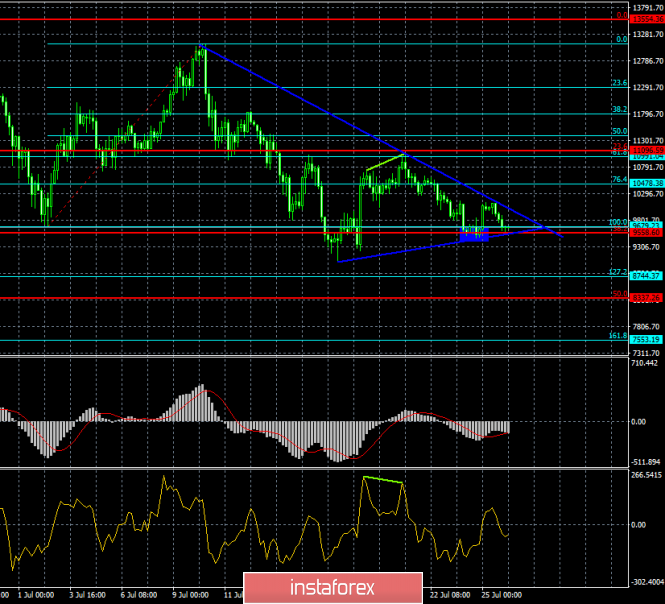
| Forecast for Bitcoin on July 26th. Germany introduces licensing of all crypto companies Posted: 26 Jul 2019 12:56 AM PDT Bitcoin – 4H.
As seen on the 4-hour chart, Bitcoin remained within the "tapering triangle" formation and performed a return to the correction level of 38.2% ($9558). At the same time, the cryptocurrency "rested" on the lower border of the "narrowing triangle". Closing of the "cue" quotes under the Fibo level of 38.2% will significantly increase the probability of a further fall in the direction of the next correction level of 127.2% ($8744). Meanwhile, the German authorities decided to seriously take up bitcoin and other cryptocurrencies. The biggest concerns are related to illegal transactions conducted through bitcoin and the financing of terrorism. Thus, under the new legislation, all companies using cryptocurrencies or blockchain will be required to obtain BaFin licenses. At the same time, the head of the Pantera Capital, Dan Morehead, said that he expects the growth of the value of bitcoin in the next six months 4 times. Morehead focuses on the fact that his company predicted the growth of Bitcoin to $ 5000 per coin when its value did not exceed only a few hundred dollars. Further, according to Morehead, bitcoin will grow exponentially and reach the value of $122000 in 2021 and $356000 - in 2022. It is difficult to say how true this prediction is. Large investors often like to give such forecasts, since they themselves are the large owners of the cryptocurrency and are interested in its growth. Thus, any such forecasts are often aimed at increasing the interest of ordinary traders in a particular cryptocurrency. What is the basis of such a calculation of the company Morehead is unknown. The Fibo grid is based on the extremes of July 2, 2019, and July 10, 2019. Forecast for Bitcoin and trading recommendations: Bitcoin made a return to the correction level of 38.2% ($9558). Thus, I recommend buying a cryptocurrency with a target of $10478, with the stop-loss order below the level of 38.2%, if there is a new rebound from the level of 38.2%. I recommend selling bitcoin with the target of $8744, and with the stop-loss order above the level of $9558, if the closure is performed under the correction level of 38.2%. The material has been provided by InstaForex Company - www.instaforex.com |









| You are subscribed to email updates from Forex analysis review. To stop receiving these emails, you may unsubscribe now. | Email delivery powered by Google |
| Google, 1600 Amphitheatre Parkway, Mountain View, CA 94043, United States | |

No comments:
Post a Comment