
Forex analysis review |
- EUR/USD. Brexit, trade war and US presidential election: the main battle between bulls and bears is yet to come
- Gold rushed up
- Dollar has set chords in recent years and its colleagues are enjoying success
- EURUSD and GBPUSD: the euro and the pound are preparing for growth in 2020. UK housing prices to increase
- January 1, 2020 : GBP/USD Intraday technical analysis and trade recommendations.
- January 1, 2020 : EUR/USD Intraday technical analysis and trade recommendations.
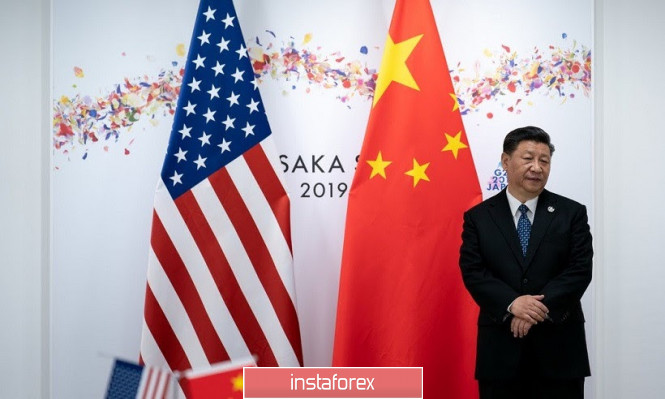
| Posted: 01 Jan 2020 02:47 PM PST The outgoing year was marked by a low volatility for the EUR/USD pair. Price fluctuations were the weakest since the introduction of the single currency in circulation. The pair met 2019 at 1.1452, while now the price is being traded in the region of the 12th figure. It is noteworthy that the price did not rise above the 14th level - the high of the year was fixed at 1.1489. The EUR/USD bears can boast of brighter achievements - they were able to push the price to the eighth figure in early autumn. The support level of 1.0880 turned out to be too tough for sellers, so the pair returned above the 1.1000 mark in November. Thus, the pair fluctuated within the 500-point range for 12 months. For comparison, in 2017, EUR/USD traders strode by almost 1700 points, rising from the third figure to 1.2000. Last year was also quite volatile - the pair rose from 1.2000 to 1.2500, after which it gradually decreased over the course of six months, reaching the 12th figure. Compared to such price fluctuations, the outgoing 2019 year looks faded. In fact, the price was circling around the 10th level, and the bulls and bears only "pulled the rope" - sellers made an attempt to go below the 9th figure, buyers tried to rise above the 14th. But in fact, the EUR/USD pair ends the year at almost the same level where it met (with a relatively small decrease). All this suggests that the main battle between bulls and bears is yet to come. Toward the close of 2019, the financial world was able to breathe a sigh of relief: China and the United States escaped the escalation of the trade war, and the British Parliament approved in the second reading a bill on Britain's exit from the European Union. The overall tension in the foreign exchange market decreased, which made it possible for the European currency to show character. In turn, the dollar came under significant pressure. The US currency was used as a safe haven in a period of uncertainty, while now the anti-risk sentiment has been replaced by a craving for risky assets. In addition, the US regulator continues to conduct overnight repo transactions, and this factor also exerts background pressure on the greenback, especially against the background of the thin market. This state of affairs will remain at least until the beginning of next week, until traders are finally included in the operating mode. If we talk about longer-term prospects, then here we are again returning to the old problems, which will remind ourselves in 2020. The focus of dollar pairs will continue to be on the trade conflict between the US and China, while the EUR/USD pair will also respond to the events around Brexit. The signing ceremony for the first phase of the deal between Washington and Beijing is due this weekend. However, then the parties will begin negotiations on the second part of the trade agreement, where the most complex and strategically important issues will be discussed. This negotiation process will be the #1 topic for dollar bulls - only the US presidential election (November 2020) can overshadow this fundamental factor. Donald Trump expects to sign the second phase of the transaction before the voting day. He needs a victory in a trade war, while the Chinese are counting on a change of power on the American political Olympus. Obviously, Trump will put pressure on China, threatening to tighten the terms of the deal in the event of his re-election. Whereas the current ratings no longer speak of the clear leadership of Joe Biden. Moreover, according to recent opinion polls, the current president maintains strong positions in key states, on which the outcome of the elections will most likely depend. The latest opinion poll shows that the head of the White House at the national level is ahead of all the main candidates from the Democratic Party. Such circumstances may have a corresponding effect on the obstinacy of the Chinese side. In any case, the negotiation process between the United States and China will have a strong impact on dollar pairs, including EUR/USD. If the parties nevertheless come to a compromise, the euro will receive strong support, as the head of the ECB associates the risks of a slowdown in economic growth in the eurozone with geopolitical factors. De-escalation of the protracted conflict will allow the European Central Bank to maintain a wait-and-see stance on the issue of monetary policy, and given the growth of key indicators, even think about raising the interest rate (especially against the background of side effects of the negative rate). The Brexit problem will also "sparkle with new colors" in 2020. The recently passed bill suggests that the transition period ending December 31 of next year will not be extended, and that concluding a trade agreement with the EU after Brexit could do without the consent of the House of Commons. This document has not yet been finalized - it will have to go through the third reading next month, and then the millstone of the House of Lords. Conservatives now have their own majority in the Lower House of Parliament, so with a high degree of probability it can be assumed that Britain will leave the EU before January 31, after which negotiations will begin within the transition period. According to many experts, the parties will not have time to agree on a trade agreement before the end of next year - the head of the European Commission has already expressed willingness to extend the negotiation period for another year or two. But Johnson is still taking a tougher stance on this issue. The increasing tension between London and Brussels will put pressure not only on the pound, but also on the euro. But if the parties nevertheless find a common denominator (at least in determining reasonable terms for the transition period), the British currency will pull the euro along with it. In general, most experts are inclined to believe that the coming 2020 will be, firstly, more volatile, and secondly, less successful for the US currency. In the context of EUR/USD, this means that in the long run the pair may rise to the middle of the 17th figure (i.e. to the upper line of the Bollinger Bands indicator on the monthly chart, which coincides with the Kijun-sen line). The next resistance level on the MN timeframe is at 1.2150 (the upper boundary of the Kumo cloud). However, it is too early to speak about these price heights. Moreover, judging by the intensity of the upward movement, we can assume that a corrective pullback to the region of the 11th figure is quite likely in early January. The material has been provided by InstaForex Company - www.instaforex.com |
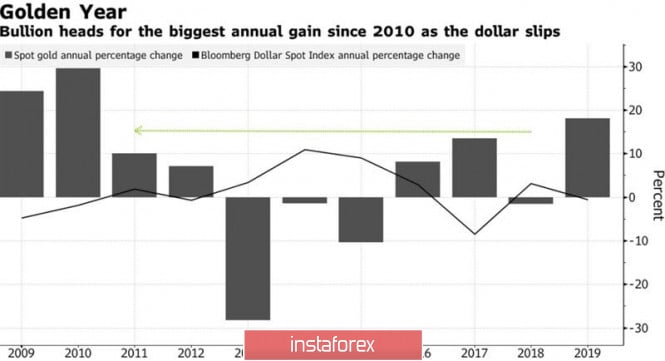
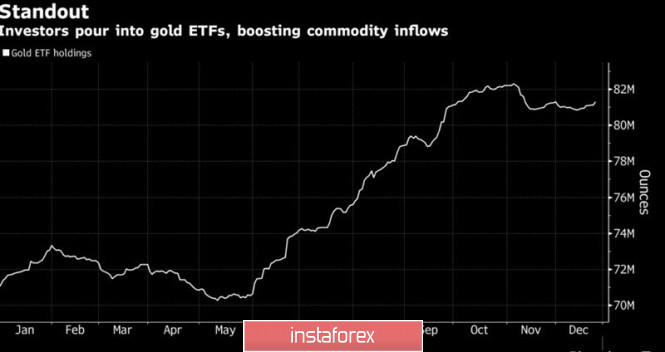
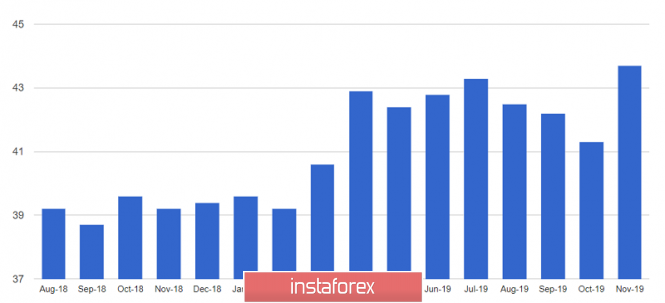
| Posted: 01 Jan 2020 02:47 PM PST The weakness of the US dollar at the end of the year made it possible for gold to eliminate most of the autumn losses associated with the de-escalation of the US-China trade conflict and head for better performance since 2010. The precious metal grew by 16.5% at the end of 2019 due to trade wars, the monetary easing cycle, Fed policies, weaknesses in major world currencies and declining global debt market returns. It is quite capable of starting 2020 on a major note, because the signing of a trade agreement by Donald Trump and Xi Jinping risks launching the S&P 500 correction process against the background of the principle of "buy by rumor, sell by facts". Gold annual dynamics While the bulls on XAU/USD are enjoying the victory, their opponents talk about the limited potential of the rally and the technical nature of gold growth at the end of December. There are no grounds for buying safe haven assets amid record peaks in US stock indices and a high global risk appetite. Trading volumes are low, probably, one of the speculators is testing the market for strength. No more. CME derivatives give only a 45% chance of the Fed loosening monetary policy in 2020, so the precious metal seems to have nowhere to draw strength. In fact, you need to understand that uncertainty will not disappear even after the conclusion of the phase one deal. Most of the tariffs against China remain in force, so there is no reason to count on a V-shaped recovery of its economy. The process will go with a creak, which will keep the demand for reliable assets high. According to a survey of 37 largest asset managers conducted by Reuters, the share of debt securities in their portfolios increased from 41.8% to 42.1% compared to November, while equity, on the contrary, decreased from 47.5% to 47%. There is no talk of any rush demand for risk. Uncertainty contributes to capital inflows into precious metals-oriented ETFs. At the end of 2019, stocks of specialized exchange-traded funds increased by $18 billion, which is the best result in three years and contrasts with the results of other ETFs focused on the commodity market. In particular, energy exchange funds lost $1.2 billion, those working with industrial metals - $ 200 million, with agricultural products - $260 million, with commodity market indices - $1.5 billion. Gold-Oriented ETF Reserves If we add to the fact that the trade war between Washington and Beijing is not over yet, the growth of political risks in the United States in connection with the presidential election and the tension between the US and the EU, which at any moment can develop into a large-scale trade conflict, the desire of investors to hide in the golden cave looks logical. It is unlikely that a sell-off in XAU/USD should be expected; I estimate the chances of the restoration of the bullish trend higher than the development of the correction. Technically, activating the Expanding Wedge pattern increases the risks of target implementation by 161.8% according to the Crab model. Drops to 23.6%, 38.2% and 50% to wave 4-5 should be used to form long positions. The material has been provided by InstaForex Company - www.instaforex.com |
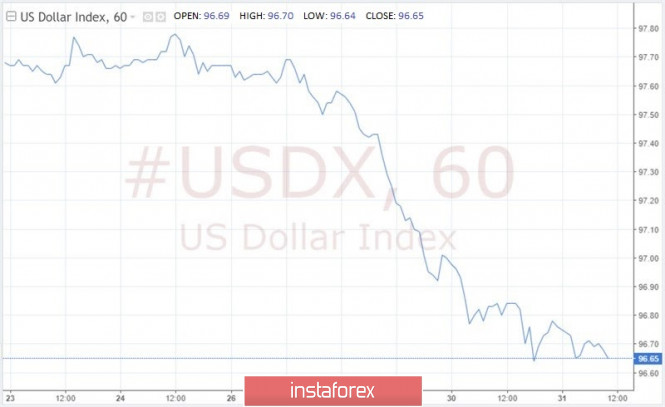
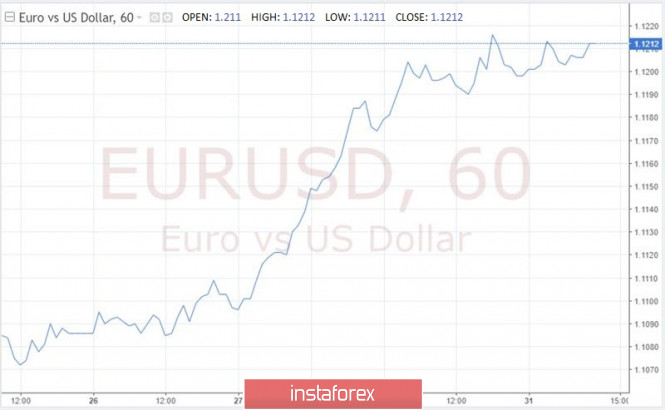
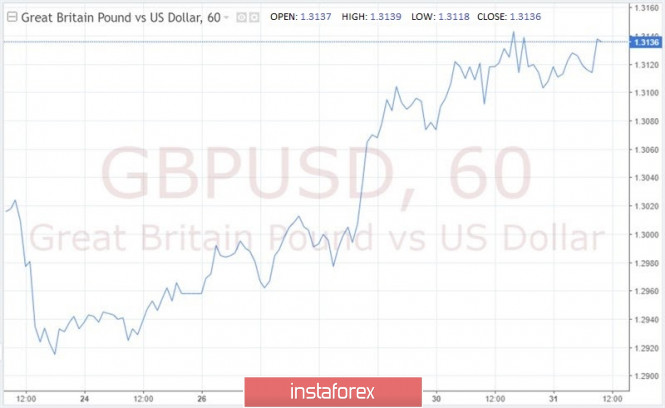
| Dollar has set chords in recent years and its colleagues are enjoying success Posted: 01 Jan 2020 02:47 PM PST The USD index sank to its lowest level in almost six months in anticipation of the new year. The greenback is still suffering because of expectations about the conclusion of a trade agreement between the United States and China following the first stage of negotiations. The financial flows of the end of the quarter and year in order to rebalance the portfolios also gravitate over the US currency. In late September – early October, the USD index peaked at around 99.5 points and has since fallen by 2.5%, showing the largest quarterly loss since March 2018. Low trading volumes at the end of the year exacerbated the general weakness of the US currency, which on Friday experienced the strongest one-day fall since June this year. "The main drivers of the weakening dollar are likely to have been an increased risk appetite caused by recent comments by the United States on a trade deal, as well as ongoing repos by the US Federal Reserve," MUFG said. "The weakness of the dollar is partly due to the fact that investors believe that trade tensions between Washington and Beijing are now unlikely to increase," said Derek Halpenny, head of global market research (in Europe, the Middle East and Africa) at MUFG. "Another negative factor for the greenback was the elimination of the problem of a lack of dollar liquidity, which the Fed introduced into the system through overnight operations. This eased concerns about a potential sharp increase in the federal funds rate," the expert added. Meanwhile, the EUR/USD pair for the first time since mid-August rose above the 1.12 mark. Signs that the eurozone economy has pushed off the bottom have helped strengthen the single European currency in recent weeks. In addition, the yield on ten-year German state bonds at the end of December is growing at a faster pace than their American counterparts, and the divergence in the dynamics of the S&P 500 and Shanghai Composite indices lends a helping hand to the bulls on EUR/USD. Business activity in the manufacturing sector of China managed to stay above the critical mark of 50, and the subindex of new export orders exceeded it for the first time since May 2018. Clearly, Beijing's fiscal and monetary stimulus measures are working, which is supporting the local stock market. US stock indices seem to have gone too far. The factor in signing the trade transaction by Donald Trump and Xi Jinping has already been put in quotes, which means that the sale of securities in order to take profits is not far off. The growing fears about a possible correction of the S&P 500 index make it possible for the single European currency to feel quite confident. According to Goldman Sachs, the euro behaves like the yen in the early 1990s and 2000s, and it is particularly sensitive to market turbulence. It is hardly worth it to be surprised. The ECB's ultra low rates have turned EUR into a funding currency. Therefore, it is quite natural that the euro will respond to a pullback in the US stock market: in this case, carry traders will actively close their own positions. If after the conclusion of a trade agreement between Washington and Beijing, the "buy by rumor, sell by facts" principle works, then the S&P 500 index will go down, and the EUR/USD pair will reach 1.1300 and 1.1350 in January. The British currency is strengthening against the US dollar for the sixth consecutive day. The pound is showing its best quarterly growth in a decade. Market participants continue to monitor developments around the exit of Great Britain from the European Union. According to the head of the Cabinet of the United Kingdom, Boris Johnson, the ratification of the agreement on Brexit will lead to a new investment boom in the country. This will make it possible for the Bank of England to tighten the monetary rate by raising interest rates. In addition to Brexit, the regulator's monetary policy may be affected by the appointment of a new head of the central bank in late January. After the referendum on UK membership in the EU, Mark Carney was clearly in no hurry with the changes in BoE, but the new leader may well change the approach to monetary policy. On January 5, the British Parliament will return from the New Year holidays and will begin to consider issues related to the duration of the Brexit transition period, which should last until the end of 2020. If MPs succeed in convincing Johnson to extend the transition period, then London will have enough time to coordinate with Brussels the preservation of access to the single market and the EU customs union. In this regard, it makes sense to keep long positions in the GBP/USD pair.  |
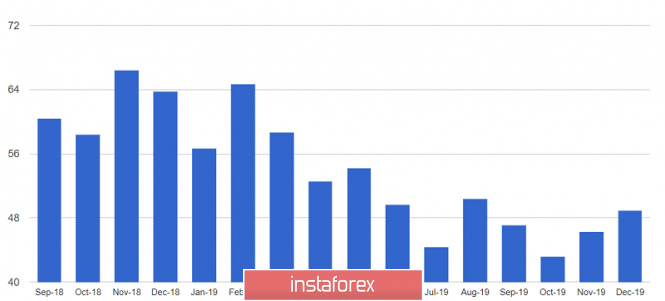
| Posted: 01 Jan 2020 02:46 PM PST The euro and the pound continue to strengthen their position against the weakening US dollar at the end of the year amid growing optimism about the prospects for the US-China trade agreement. Given that there are no other important fundamental statistics during the pre-holiday period, traders are mainly focused on any news related to the agreement. Some pressure on the US dollar is also exerted by the Federal Reserve's ongoing repos through which banks are provided with the necessary liquidity. From the data released, one can note a report on the number of contracts for the sale of homes in the United States. According to information from the National Association of Realtors, the index of signed home sales contracts rose by 1.2% in November, while economists had expected the index to grow by 1%. Sales rose by 7.4% compared to the same period of the previous year. Even despite the limited supply on the market, sales grew due to lower Fed interest rates this year. The start of the next year should take place on a positive note, but the proposal still does not keep pace with significant demand, which will only increase as the Fed returns to the average level of interest rates, which will lead to more expensive financing. The PMI data for Chicago and Dallas supported the US dollar in the afternoon of Tuesday, but this did not lead to a more serious strengthening against the euro and the pound. According to the report, Chicago Purchasing Managers PMI Index in December this year was 48.9 points, almost returning to around 50 points. However, its stay below the level of 50 points indicates a continuing decline in business activity. Economists had expected the business barometer to be 47.4 points. Production activity in the area of responsibility of the Federal Reserve Bank of Dallas also recovered in December. According to the report, the production index calculated by the Fed-Dallas in December 2019 was 3.6 points, after falling to -2.4 points in November. Business activity in December fell to -3.2 points from -1.3 points in November, but the indicator of expectations of companies rose to 1.3 points. As for the technical picture of the EURUSD pair, it should be noted the efforts of buyers of risky assets, who, at the end of the year, seizing the moment, are strengthening their positions against the US dollar. The problem for the bulls is resistance at 1.1215, which has already been tested several times. Only a breakout of this level will increase the demand for a trading instrument, which will lead to new highs in the region of 1.1240 and 1.1270. If the pressure on risky assets returns, and this can happen quite easily in a thin market, then only 1.1170 area will provide support. GBPUSD The British pound continues to regain its position against the US dollar. Yesterday's evidence that the number of mortgages in the UK has increased indicated a growing indifference to residents' Brexit problems. According to Octane Capital and UK Finance, the number of mortgages approved increased by 6.8% in November 2019 compared to the same period last year, to 43,589. The number of approved repeat collateral agreements also increased by 13% to 34,653 . The main demand is associated with a gradual recovery in housing prices after a period of uncertainty with Brexit and sluggish economic growth, which constrained the housing market. Now that the situation seems to have partially cleared up, the prospect of price recovery worries people buying housing for the first time, which fuels market demand. The material has been provided by InstaForex Company - www.instaforex.com |
| January 1, 2020 : GBP/USD Intraday technical analysis and trade recommendations. Posted: 01 Jan 2020 08:31 AM PST
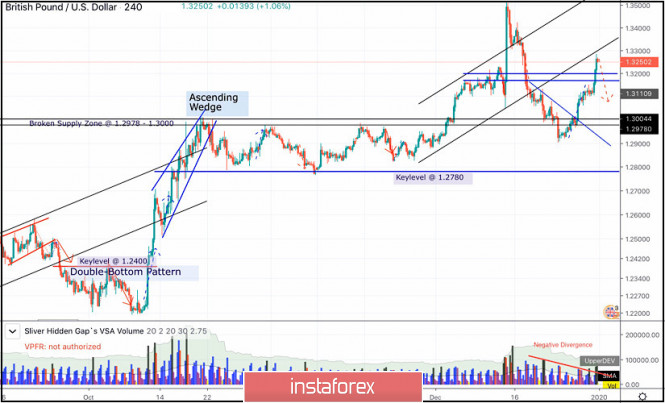
In the period between October 17 to December 4, the GBP/USD pair has been trapped between the price levels of 1.2780 and 1.3000 until December 4 when bullish breakout above 1.3000 was achieved. Moreover, a newly-established short-term bullish channel was initiated on the chart. The GBPUSD has recently exceeded the upper limit of the depicted bullish channel on its way towards 1.3500 where the pair looked quite overpriced. This was followed by successive bearish-engulfing H4 candlesticks which brought the pair back towards 1.3170 quickly. Further bearish decline was pursued towards 1.3000 which got broken to the downside as well. Technical short-term outlook turned into bearish since bearish persistence below 1.3000 was established on the H4 chart. Hence, further bearish decline was expected towards 1.2840 - 1.2800. However, earlier signs of bullish recovery manifested around 1.2900 denoted high probability of bullish breakout to be expected. Intraday technical outlook turned into bullish after the GBP/USD has failed to maintain bearish persistence below the newly-established downtrend line. That's why, bullish breakout above 1.3000 was anticipated. Thus allowing the current Intraday bullish pullback to pursue towards 1.3250 (the backside of the broken channel) where bearish rejection and another bearish swing can be watched by conservative traders. Bearish reversal scenario around 1.3250 is supported by the recent negative divergence as depicted on the chart. If so, Intraday bearish target would be projected towards 1.3000 provided that early bearish breakout below 1.3190 is achieved. The material has been provided by InstaForex Company - www.instaforex.com |
| January 1, 2020 : EUR/USD Intraday technical analysis and trade recommendations. Posted: 01 Jan 2020 08:22 AM PST
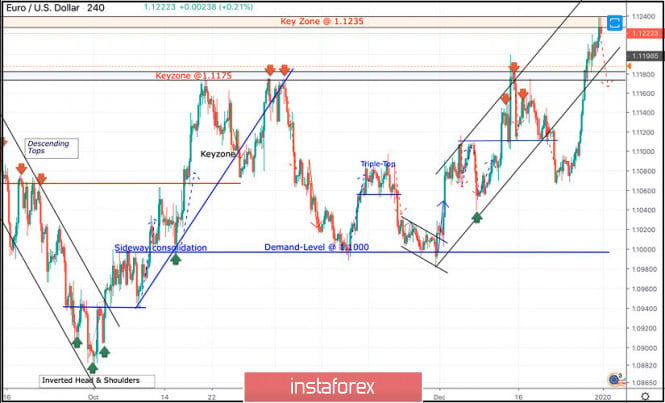
Since November 14, the price levels around 1.1000 has been standing as a significant DEMAND-Level which has been offering adequate bullish SUPPORT for the pair on two successive occasions. Shortly-after, the EUR/USD pair has been trapped within a narrower consolidation range between the price levels of 1.1000 and 1.1085-1.1100 (where a cluster of supply levels and a Triple-Top pattern were located) until December 11. On December 11, another bullish swing was initiated around 1.1040 allowing recent bullish breakout above 1.1110 to pursue towards 1.1175 within the depicted newly-established bullish channel. Initial Intraday bearish rejection was expected around the price levels of (1.1175). Quick bearish decline was demonstrated towards 1.1115 (Intraday Key-level) which got broken to the downside as well. On December 20, bearish breakout of the depicted short-term channel was executed. Thus, further bearish decline was demonstrated towards 1.1065 where significant bullish recovery has originated. The current bullish pullback towards 1.1235 (Previous Key-zone) should be watched for bearish rejection and another valid SELL entry. On the other hand, bearish breakout below 1.1175 is mandatory to allow next bearish target to be reached around 1.1120. Trade recommendations : Conservative traders should wait for bearish rejection signs around the current price levels of (1.1235) as a valid SELL signal. Bearish projection target to be located around 1.1175 and 1.1120. Any bullish breakout above 1.1250 invalidates the mentioned scenario. The material has been provided by InstaForex Company - www.instaforex.com |


| You are subscribed to email updates from Forex analysis review. To stop receiving these emails, you may unsubscribe now. | Email delivery powered by Google |
| Google, 1600 Amphitheatre Parkway, Mountain View, CA 94043, United States | |

No comments:
Post a Comment