
Forex analysis review |
- Prospects and trends for gold in January and February 2020
- EUR/USD. January 16. Results of the day. Euro slumped due to strong US retail sales data
- EUR/USD: semi-empty deal, ECB minutes and strong US data
- USD/JPY: although the dollar has momentous plans, it is too early to write off the yen
- EUR/USD: Washington and Beijing shook hands, but the euro is in no hurry to put pressure on gas
- Short-term Elliott wave analysis on GBPUSD
- EURUSD rejected at short-term resistance
- Gold is stuck below major inflection point
- January 16, 2020 : EUR/USD Intraday technical analysis and trade recommendations.
- January 16, 2020 : GBP/USD Intraday technical analysis and trade recommendations.
- EUR/USD for January 16,2020 - Sell zone on the EUR and overrbought condition, potential for testing 1.1100
- Gold 01.16.2020 - Sell zone on the Gold, downward target is set at the price of $1.536
- Evening review for EURUSD for 01/16/2020. Strong US data put pressure on the euro
- BTC analysis for 01.16.2020 - Is this end of the upward correction ? Watch for selling opportunities
- EUR/USD. A trade deal between the United States and China. The view from the inside. Trump implements the precepts of George
- EUR/USD. January 16. The long-term trading idea persists. Perspective – 1.0851
- GBP/USD. January 16. Two channels at once resist further growth of the pound
- Trading recommendations for NZD/USD for January 16, 2020
- USD/CAD bounce in progress above support!
- EUR/USD bouncing off support, potential for further rise!
- USD/JPY potential bounce coming!
- Technical analysis recommendations for EUR/USD and GBP/USD on January 16
- Trading recommendations for GBPUSD for January 16, 2020
- Analysis of EUR/USD and GBP/USD for January 16. Eurozone's economic reports continue to disappoint
- Trader's Diary: EUR/USD on 01/16/2020, What did the fed say?
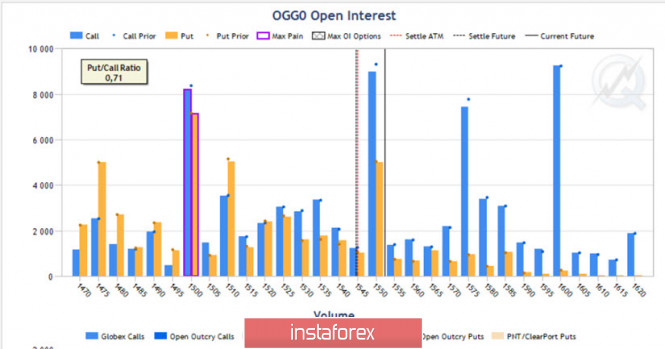
| Prospects and trends for gold in January and February 2020 Posted: 16 Jan 2020 03:37 PM PST The consolidation in the gold market ended with the New Year holidays as well as rocket salvos in Iraq, where the United States killed the commander of the Kudes Iranian unit, Qassem Soleimani. Thank God, the global war did not happen, but the nerves of the investors completely lost, and they rushed to buy gold in full accordance with the forecast published in early December 2019. However, the time has come to look at the prospects of the precious metal and make adjustments to the assessment of the situation. As we know, the position of traders in futures contracts traded on the CME exchange has the greatest impact on the price of gold. The latest data from the Traders Obligations Report - Commitments of Traders (COT) Reports, published by the US Commodity Futures Commission - CFTC, indicates an increase in the volume of new money entering the market. In addition, the Open Interest of the gold futures contract grew from 926 thousand to 1197 thousand contracts, or almost one third between November 29 and January 10. Such an increase in the interest of market participants in gold, which took place against the backdrop of a rise in stock indices, suggests that the departure of the price of gold to the level of $ 1,600 per troy ounce was not an accident caused by the geopolitical situation. The assassination of the general was just an excuse for the precious metal to begin to rise again after a period of consolidation that lasted until the end of the fourth quarter. Moreover, it is very important that the increase in the price of gold was supported by speculators Managed Money, whose long positions during the period from December to January grew from 225 thousand to 300 thousand contracts. According to the CFTC classification, Managed Money are a priori net buyers. Thus, the demand for gold from buyers was accompanied by the opening of new positions in the futures contract, which suggests fundamental reasons for the continuation of the current trend. Due to this, exchange traders felt the potential and began to increase positions. If the increase in the price of gold was caused only by the development of events in the Middle East, then, firstly, we would not see a constant influx of new money that occurred in December, and secondly, Managed Money, which are speculators, could simply not react on the events that are happening. So, for example, what happened in September 2019 and January 2020 in the oil market. The attack on the Saudi oil infrastructure was not supported by the influx of new money into the market, and speculators were in no hurry to open new long positions, which subsequently led to a decrease in oil prices. No demand - no price increase. In December, speculators bought oil, but almost no new positions were opened in the futures, which led to a decrease in oil prices as soon as the situation in the Persian Gulf area stabilized. However, we have an increase in Open Interest in gold and an increase in purchases by speculators at the same time, which qualitatively distinguishes this situation from the situation in the oil market. On the other hand, the price of gold declined slightly after the crisis between Iran and the United States was resolved, and this is natural, but do not be fooled by the possibility of a potential reversal, since most likely there will not be a deep decline in the gold market. We will analyze the positioning of traders in option contracts. The most liquid option contract now is the February contract OGG0 with the closure on January 28 (Fig. 1). Figure 1: Open Interest in an OGGO Option Contract. First of all, the significant predominance of "call" options over "put" options is noteworthy. The Put / Call Ratio coefficient is 0.71. This means that there are only 71 Put options for every 100 Call options. In the context of the growth of Open Interest, optional barriers may not withstand and miss the price higher. With this ratio, the importance of the Max Pain point located at 1500 also decreases, and returning to this point at the time the option contract expires is becoming less and less likely. This must be taken into account when opening gold sales positions. Option barriers hold the price well, but only when there is no trend on the market. In this regard, it can be assumed that the levels of optional support are at 1510 and 1500. There are also graphic levels of price support, where gold can return by the end of the month for purely technical reasons. After that, there is a possibility of further price growth over the next three to six months, which implies a rise in gold to the level of $ 1,750 per troy ounce. Thus, sales to the levels of 1,500-1,510 dollars will be inappropriate, but such a price can be an ideal point for buying gold, unless, of course, by that time there will be a change in the mood of buyers in the futures market. Short-term goals for such purchases may be levels 1500, 1575 and 1600, formed by options such as "Call". Today, the World Gold Council - published its forecast for 2020. The forecast indicates the main factors that, in the opinion of the Council, will affect the price of gold this year. It is assumed that financial uncertainty and low interest rates in most developed economies will support the price of gold, as investors will seek new sectors to protect investments and generate income. As a result, demand from central banks will also remain high. This, combined with investor interest, will allow gold to be added back to its value in all currencies. According to WGC experts, the price impulse and positioning of traders will also support the price of gold. At the same time, volatility and expectations of weaker economic growth in the short term may lead to softer consumer demand, but structural economic reforms in India and China will support consumer demand in the long term. Thus, traders trading can earn on price fluctuations by selling and buying precious metals on the best trading conditions, but investors should not forget that gold has provided them with a yield higher than the US dollar over the past twenty years, while performing a protection function risk investment. By investing in gold and trading it in the short term, an investor can not only profit from fluctuations in price quotes, but also insure himself against unforeseen market risks. Be very careful and follow the rules of money management. The material has been provided by InstaForex Company - www.instaforex.com |
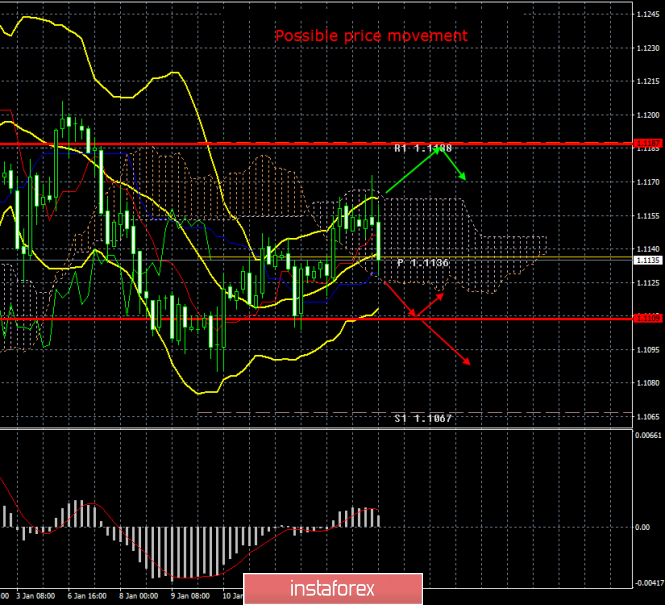
| EUR/USD. January 16. Results of the day. Euro slumped due to strong US retail sales data Posted: 16 Jan 2020 02:38 PM PST 4-hour timeframe Amplitude of the last 5 days (high-low): 28p - 44p - 34p - 41p - 44p. Average volatility over the past 5 days: 39p (weak). The EUR/USD pair ends the penultimate trading day of the week with a decline. From our point of view, this fall is simply obliged to receive development. Again, we are forced to list a whole list of factors that argue that the euro should decline. Let's start with the technical ones. The euro/dollar pair with grief in half overcame the critical line, formed a weak Golden Cross, hardly entered the Ichimoku cloud and was unable to overcome the Senkou Span B. line. At the moment, the pair's quotes have returned to the critical line. All this speaks in favor of the fact that the bulls do not have enough strength to form a new upward trend. We add average volatility here that has decreased to the value and it becomes clear that traders are slowly leaving the market, and not the other way around. We have listed the fundamental factors a great many times. The general fundamental background remains unchanged, clearly in favor of the dollar. To some extent, it can be noted that the signing of the first phase of the trade agreement between China and the United States plays into the hands of the euro currency, but this is a very subtle and ambiguous factor. In any case, given the average volatility, we can say with more confidence that the signing of the deal did not help much of the currencies. Macroeconomic data also continues to delight buyers of the US currency, and upset investors in euros. Today in Germany the consumer price index for December was published, which has not changed compared to November and amounted to 1.5% YOY. There was no particular market reaction to it since there were no changes in this indicator. At the same time, NOT improving the situation in the locomotive of the European economy speaks in favor of the fact that pan-European inflation is unlikely to accelerate in December. The consumer price index in the EU will be published tomorrow, forecast +1.3% YOY. What do we have on the basis of inflation indicators? Inflation is weak in Germany, while it is extremely weak in the EU (and this is even taking into account the acceleration in recent months from 0.7% to 1.3%). What do we have in the United States? Inflation accelerated to 2.3% YOY. It seems that the only factor that restrains the euro from a new sharp fall is the fact that one of the currencies cannot constantly fall in price. Pullbacks, corrections are required, even if the fundamental background does not change. This is what the euro is saving now, as it was saving throughout 2019. A report on retail sales was also published in the United States today, which exceeded forecast values and amounted to +0.3% MOM. The "retail control group" increased by 0.5%, as well as retail sales excluding automobiles by 0.7%. It remains only to wait for the speech of Christine Lagarde and evaluate her rhetoric ... Meanwhile, many analysts and experts continue to analyze the agreement between Beijing and Washington, trying to understand many issues. One of these questions is: "Can we assume that China has succumbed to American oppression?" To some extent, the answer is yes. However, this concession will benefit China, the United States, and the whole world. Now, traders need to focus their attention on pressing issues, and not on signing the "first phase", discussing the "second phase". It should be recognized that the topic of the trade war practically had no direct effect on the foreign exchange market for a year and a half . It had an impact through the economic indicators of the European Union and the United States (if we talk about the euro/dollar pair). As a result of this period of time, the European economy weakened, and the US sustained a blow thanks to three reductions in the Federal Reserve's key rate. Thus, the US currency has excellent reasons to continue to rise in price, and traders need to pay more attention to macroeconomic statistics. Trading recommendations: The EUR/USD pair continues to adjust and has failed to overcome the Senkou Span B. line. Thus, now it is recommended for traders to wait for the pair to consolidate back below the Kijun-sen line and resume trading on the decline with targets at 1.1109 and 1.1067. It will be possible to consider purchases of the euro/dollar pair no earlier than when traders of the Senkou Span B line have overcome the first goal, the resistance level of 1.1188. Explanation of the illustration: Ichimoku indicator: Tenkan-sen is the red line. Kijun-sen is the blue line. Senkou Span A - light brown dotted line. Senkou Span B - light purple dashed line. Chikou Span - green line. Bollinger Bands Indicator: 3 yellow lines. MACD indicator: Red line and bar graph with white bars in the indicators window. Support / Resistance Classic Levels: Red and gray dotted lines with price symbols. Pivot Level: Yellow solid line. Volatility Support / Resistance Levels: Gray dotted lines without price designations. Possible price movements: Red and green arrows. The material has been provided by InstaForex Company - www.instaforex.com |
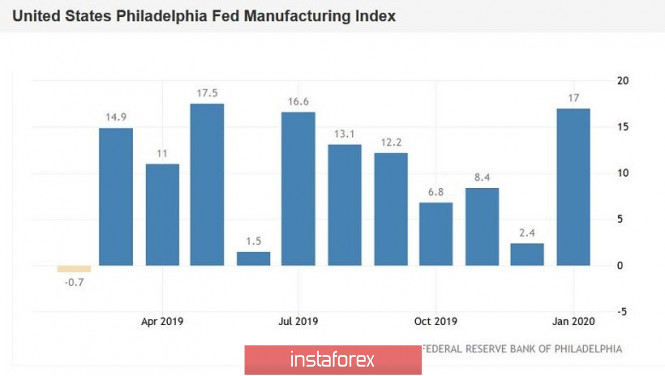
| EUR/USD: semi-empty deal, ECB minutes and strong US data Posted: 16 Jan 2020 02:38 PM PST So, the long-awaited event took place yesterday: US President Donald Trump and Vice Premier of the State Council of the PRC Liu He signed the first phase of the trade deal, the negotiation process on which lasted more than six months. The fact of a ceasefire in a trade war was not a surprise - traders played this informational occasion in December. Therefore, the main intrigue was the details of the agreement reached. The dollar did not find any support for itself here. As a result of the signing ceremony, it became clear that the main negotiations on the most complex, key and strategically important issues are yet to come. Even the parties postponed the issue of canceling the introduced tariffs to the second phase of the negotiation process. This fact disappointed the dollar bulls: today's truce looks too shaky. And if the first phase of the negotiations was not easy for the parties, the second stage will be incomparably harder. All this suggests that it will be difficult for dollar bulls to develop a large-scale upward trend this year, since the "Damocles Sword" of US-Chinese relations will hang over the greenback for several months. In turn, today, the European currency received some support from the ECB - the published minutes of the December meeting showed that a wait-and-see attitude would be preserved. But let's start with events from the US. According to the agreements reached, China pledged to import US products, agricultural products and energy products from the United States for two years worth $200 billion. In turn, Washington finally abandoned the "December" duties, which were supposed to take effect a month ago. The White House planned to increase duties on the import of many Chinese goods, including mobile phones, smartphones, toys and laptops. At the same time, Donald Trump decided to maintain the current duties on Chinese goods, although earlier there were rumors of a "complete amnesty". According to the head of the White House, the issue of canceling the remaining additional tariffs will be discussed in the framework of the discussion of the second phase of the trade transaction. It is obvious that the American president simply retained the lever of pressure on Beijing in order to change the role of the "good and bad cop" during the further dialogue. This tactic worked last year, but now many experts doubt that China will make significant concessions to Washington. After all, the second phase provides for significant changes in the industrial policy of China and the expansion of access for US financial companies to the Chinese market - the US is demanding structural reforms from the Chinese. However, most analysts doubt that the negotiations of the second stage will be completed before November of this year, that is, before the US presidential election. Given the precarious political situation of Trump, the Chinese will certainly not be in a hurry to burden themselves with such obligations. In other words, according to the vast majority of analysts, the second stage of negotiations will be much tougher. As part of the first stage of the dialogue, the countries made relatively insignificant concessions to each other - at least in comparison with what is to be discussed this year. Under such conditions, the dollar did not find reasons for strengthening - and, in my opinion, it is quite justified. Nevertheless, the upward impulse of the EUR/USD pair also did not receive its continuation - the pair fell back to the level of 1.1130 during the US session. Thus, traders responded to the release of quite good macroeconomic data. After the publication of weak Nonfarms and slurred inflation indicators, today's numbers have pleased dollar bulls. December data on retail sales were above zero, reaching 0.3%. Excluding car sales, this figure exceeded forecast values, reaching 0.7% (i.e., a 5-month high). I was also surprised by the Fed-Philadelphia manufacturing index. This indicator immediately jumped to 17 points, with a forecast of growth of only 3.7 points. Such a fundamental picture returned the demand for the US currency, which made it possible for EUR/USD bears to extinguish the upward impulse. Nevertheless, the pair still remains within the 11th figure, waiting for the next news drivers. The European currency also received little support today. The published minutes of the last ECB meeting confirmed the wait-and-see attitude of the regulator. Members of the central bank expressed cautious optimism about the latest macroeconomic reports (first of all, we are talking about restoring core inflation) and noted the weakening concern about foreign trade. And although the ECB has listed and continuing risks (for example, in the field of industrial production), traders drew attention to a rather hawkish wording. Regulator members said the ECB's monetary policy could be adjusted to avoid "unwanted side effects." A rather encouraging phrase, given the dynamics of inflationary processes in the eurozone. Thus, today's confrontation between bulls and bears of EUR/USD ended in a draw. After the price jumped to the level of 1.1170, the pair plunged to the daily low of 1.1128. But sellers also could not enter the 10th figure, after which the price got stuck in a flat. In my opinion, the dollar is still vulnerable, while the positive effect of today's releases will quickly disappear. From a technical point of view, the pair is still on the middle line of the Bollinger Bands indicator on the daily chart, thereby demonstrating the uncertain positions of both bulls and bears. The support level is 1.1050 (the lower line of the Bollinger Bands indicator, which coincides with the upper boundary of the Kumo cloud on D1), and the resistance level is 1.1210 (the upper line of Bollinger Bands is on the same time frame). The material has been provided by InstaForex Company - www.instaforex.com |
| USD/JPY: although the dollar has momentous plans, it is too early to write off the yen Posted: 16 Jan 2020 02:38 PM PST Nissay Asset Management believes that the greenback should support the continued demand of Japanese investors for US Treasury bonds. "We already saw USD/JPY support when the pair fell below 108 last week," said Toshiya Matsunami, a Nissay analyst. "US Treasuries will remain in the spotlight of Japanese funds as they continue to search for sources of profit abroad over the low interest rates at home. Funds may avoid buying debt in emerging markets, given their vulnerability to political risks. The dollar is expected to grow, supported by strong US economic data in 2020," he added. The expert predicts that by the end of the year USD/JPY may rise to 112. However, it does not exclude that in case the pair sharply grows, the level of 115 can be reached. "The uncertainties associated with the two main risks that have affected investor sentiment over the past two years, the trade dispute between the US and China and Brexit, have decreased, easing investor concerns about the damage to the global economy. Therefore, the USD/JPY trading range seems to be gradually shifting upward, to 110-115 from 105-110," said Kengo Suzuki, chief currency strategist at Mizuho Securities. Meanwhile, Sumitomo Mitsui Trust Bank experts doubt the potential for further USD/JPY growth. According to them, the pair became vulnerable to sales after the signing of the first phase of the US and China trade deal. "The trade agreement was priced. At the same time, uncertainty remains regarding the timing of the start of the second stage of negotiations, as well as the implementation of the provisions of the first stage. If the trade negotiations between Washington and Beijing stall, then USD/JPY may drop to 106-107," the analysts said. The material has been provided by InstaForex Company - www.instaforex.com |
| EUR/USD: Washington and Beijing shook hands, but the euro is in no hurry to put pressure on gas Posted: 16 Jan 2020 02:38 PM PST Investors reacted rather coolly to Washington and Beijing signing the first phase of the deal. The main currency pair was indifferent to this event. The agreements reached suggest that China pledges to increase purchases of US products by $200 billion over two years, and the United States promises not to introduce new tariffs on imports of goods from China. Everything looks great at first glance, but investors understand that the uncertainty has not disappeared. Experts doubt that Beijing will be able to buy so much. Deliveries of $360 billion from China to the United States are still under duties. Moreover, it is not a fact that the signed agreement will reduce the deficit of US foreign trade. In the 12 months that ended in November, the US negative trade balance with China decreased by $56 billion, while with the rest of the world, by contrast, it increased by $49 billion. It should be noted that before the start of the trade conflict of the two largest economies in the world, the average tariff for Chinese imports was 3% in 2018, and at 8% for the US. Currently, even taking into account the agreements reached, 20% from both sides. "The details of the signed first phase of the US-China trade agreement do not seem to eliminate the risk that China might again be called the currency manipulator," said John Velis, strategist at Bank of New York Mellon. "Lack of details about the mechanism for monitoring and implementing the interim agreement can also be a source of instability," he added. Thus, the "historical agreement", as US President Donald Trump called it, is not the end of the trade war, but only a ceasefire. Most likely, trade frictions will remain the main driver of exchange rate formation on forex, as the leading central banks have so far gone into the shadows. They can neither raise interest rates (sluggish economic growth and inflation do not allow them to do this), nor reduce them by virtue of reaching the lower limit of their capabilities. In such conditions, investors are unlikely to turn a blind eye to macro statistics. If earlier it gave market participants clues about changing the worldview of regulators, now it is perceived by them as an answer to the question about the timing of economic recovery in the eurozone and China. The EUR/USD pair has sluggishly reacted to the signing by the United States and China of an intermediate trade agreement, since this event has already been taken into account in quotations. The intermediate goals are still 1.1164 and 1.1195 for the pair. If the pressure on the euro intensifies, then we monitor the level of 1.1115. If it does not resist, a new wave of sales of the euro is possible with a target at 1.1070. Strong statistics on Chinese GDP for the fourth quarter and the correction of the S&P 500 index could be catalysts for the growth of EUR/USD above 1.12. The material has been provided by InstaForex Company - www.instaforex.com |
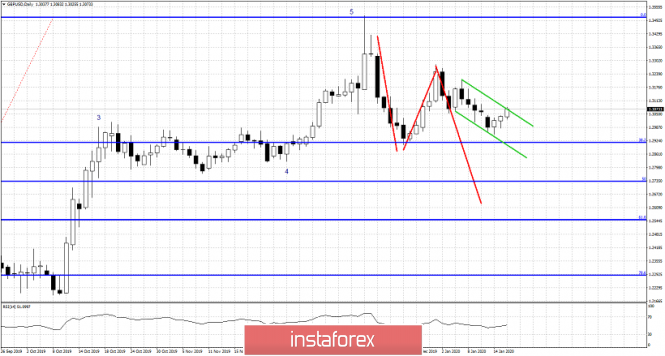
| Short-term Elliott wave analysis on GBPUSD Posted: 16 Jan 2020 01:59 PM PST GBPUSD is expected to move lower from current levels. Trend remains bearish as price continues to make lower lows and lower highs. Our view is that price is inside a corrective wave that should at least make a move below 1.29
Green lines- bearish channel Price is still holding above the 38% Fibonacci retracement confirming the importance of this support level. Price is still inside a bearish channel and we should soon see a rejection. GBPUSD could be forming something more complex than a textbook A-B-C correction. Only time will tell. The material has been provided by InstaForex Company - www.instaforex.com |
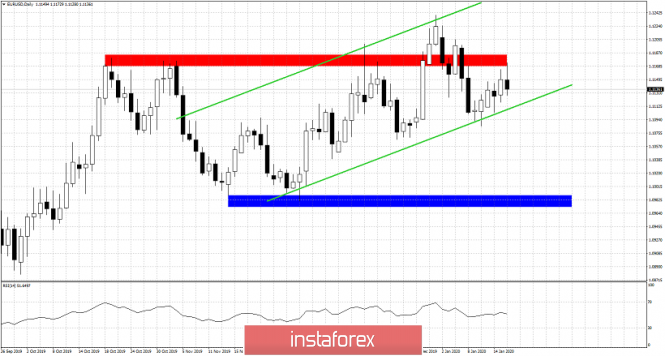
| EURUSD rejected at short-term resistance Posted: 16 Jan 2020 01:54 PM PST EURUSD bulls tried to pull price above 1.1170-1.1188 but no luck until now. The rejection at the resistance levels will most probably bring price back towards the lower channel boundary. Bulls need to break above 1.1180-1.1190.
Red rectangle - resistance Blue rectangle - support Green lines -bullish channel EURUSD is still bouncing higher off the January 10th low. If this level is broken I would expect price to move lower towards the lower green channel boundary. Short-term trend is mixed as price has no clear direction. Staying below the red rectangle area is a bearish sign that will put the blue rectangle into bears crosshair. The material has been provided by InstaForex Company - www.instaforex.com |
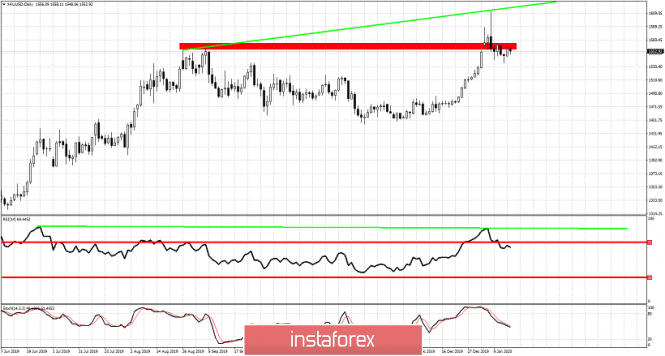
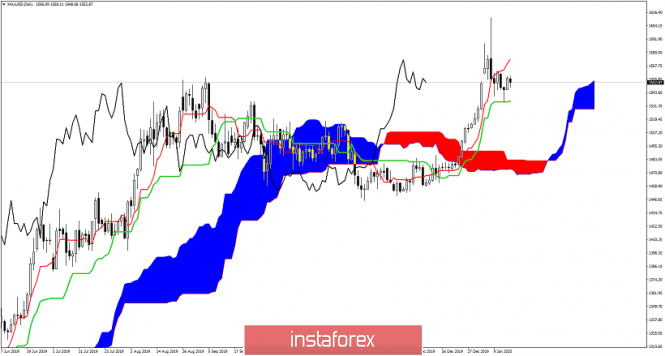
| Gold is stuck below major inflection point Posted: 16 Jan 2020 01:48 PM PST Gold price remains in a short-term bearish trend. Price has recently bounced from $1,535 towards $1,550-55 but price remains below key resistance. Gold price needs to overcome $1,564 in order for bulls to regain control of the trend.
Green line - bearish divergence Red rectangle - resistance area Gold price is challenging important resistance area. Both oscillators are negatively sloped. As long as price is below $1,563 trend will remain bearish.
 |
| January 16, 2020 : EUR/USD Intraday technical analysis and trade recommendations. Posted: 16 Jan 2020 07:12 AM PST
Since November 14, the price levels around 1.1000 has stood as a significant DEMAND-Level offering adequate bullish SUPPORT for the pair on two successive occasions. During this Period, the EUR/USD pair has been trapped within a narrow consolidation range between the price levels of 1.1000 and 1.1085-1.1100 (where a cluster of supply levels and a Triple-Top pattern were located) until December 11. On December 11, another bullish swing was initiated around 1.1040 allowing recent bullish breakout above 1.1110 to pursue towards 1.1175 within the depicted short-term bullish channel. Initial Intraday bearish rejection was expected around the price levels of (1.1175). Moreover, On December 20, bearish breakout of the depicted short-term channel was executed. Thus, further bearish decline was demonstrated towards 1.1065 where significant bullish recovery has originated. The recent bullish pullback towards 1.1235 (Previous Key-zone) was suggested to be watched for bearish rejection and another valid SELL entry. Suggested bearish position has achieved its targets while approaching the price levels around 1.1110. As expected, the Key-Level around 1.1110 has provided some bullish rejection. That's why, the previous bullish pullback was expected to pursue towards 1.1140 and 1.1175 where the depicted key-zone as well as the recently-broken uptrend are located. Recent signs of bearish rejection are being demonstrated around 1.1175. That's why further bearish decline is anticipated towards 1.1110. For the bearish side of the market to dominate, bearish persistence below 1.1110 is needed to enable further bearish decline towards 1.1060 and probably 1.1040. Trade recommendations : Conservative traders should consider the current bullish pullback towards the price levels of (1.1175) as another valid SELL signal. Bearish projection target to be located around 1.1120 and probably 1.1060. Any bullish breakout above 1.1190 invalidates the mentioned bearish trading scenario. The material has been provided by InstaForex Company - www.instaforex.com |
| January 16, 2020 : GBP/USD Intraday technical analysis and trade recommendations. Posted: 16 Jan 2020 06:16 AM PST
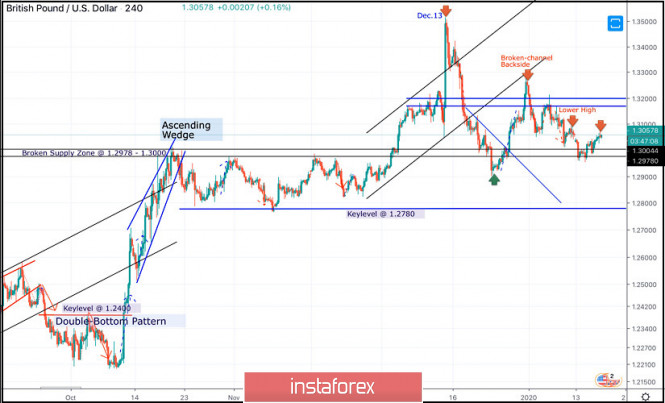
On December 13, the GBPUSD pair looked overpriced around the price levels of 1.3500 while exceeding the upper limit of the newly-established bullish channel. On the period between December 18 - 23, bearish breakout below the depicted channel followed by initial bearish closure below 1.3000 were demonstrated on the H4 chart. However, earlier signs of bullish recovery were manifested around 1.2900 denoting high probability of bullish pullback to be expected. Thus, Intraday technical outlook turned into bullish after the GBP/USD has failed to maintain bearish persistence below the newly-established downtrend line. That's why, bullish breakout above 1.3000 was anticipated. Thus, allowing the recent Intraday bullish pullback to pursue towards 1.3250 (the backside of the broken channel) where bearish rejection and another bearish swing were suggested for conservative traders in previous articles. Intraday bearish target are projected towards 1.3000 and 1.2980 provided that the current bearish breakout below 1.3170 is maintained on the H4 chart. Please also note that two descending highs were recently demonstrated around 1.3120 and 1.3090 which enhances the bearish side of the market. Bearish breakdown below 1.2980 is needed first to enhance further bearish decline towards 1.2900, 1.2800 and 1.2780 where the backside of the previously-broken downtrend is located. In the Meanwhile, Intraday traders can watch any bullish pullback towards the depicted price zone (1.3170 - 1.3200) for bearish rejection and another valid SELL entry with intraday bearish targets projected towards 1.3000 and 1.2980. The material has been provided by InstaForex Company - www.instaforex.com |
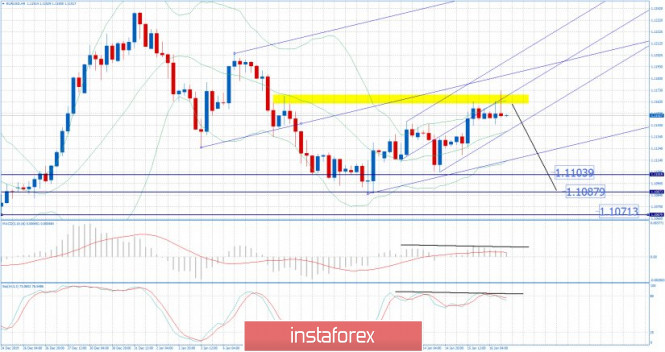
| Posted: 16 Jan 2020 06:08 AM PST EUR has been trading upwards. The price tested and rejected of the level of 1.1167. I see further downside on the EUR and potential re-test of 1.1103 and 1.1072.
The rejection of the mini Pitchfork median line is the early trigger for the downside. My advice is to watch for selling opportunities on the rallies using intraday-frames 5/15 minutes. MACD oscillator is showing decrease on the upside momentum, which is sign of the weak buying and potential for downside cycle... Resistance levels are set at the price of 1.1173 and 1.1180 Support levels and downward targets are set at the price of 1.1103, 1.1087 and 1.1071. The material has been provided by InstaForex Company - www.instaforex.com |
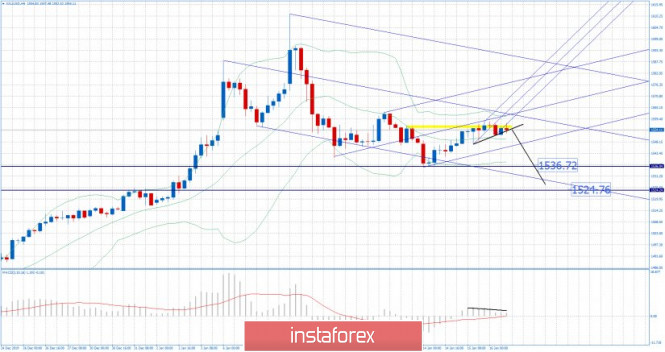
| Gold 01.16.2020 - Sell zone on the Gold, downward target is set at the price of $1.536 Posted: 16 Jan 2020 06:01 AM PST Gold has been trading sideways at the price of $1.553. The price tested and rejected of the level of $1.557. I see further downside on the Gold and potential re-test of $1.536 and $1.524.
The breakout of the mini Pitchfork upward channel is the early trigger for the downside. My advice is to watch for selling opportunities on the rallies using intraday-frames 5/15 minutes. MACD oscillator is showing decrease on the upside momentum, which is sign of the weak buying. Resistance levels and upward targets are seen at the price of $1.558 and $1.562. Support levels and downward targets are set at the price of $1.536 and $1.524. The material has been provided by InstaForex Company - www.instaforex.com |
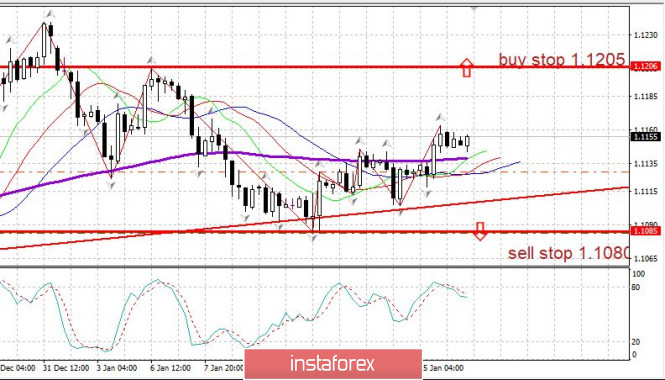
| Evening review for EURUSD for 01/16/2020. Strong US data put pressure on the euro Posted: 16 Jan 2020 05:51 AM PST
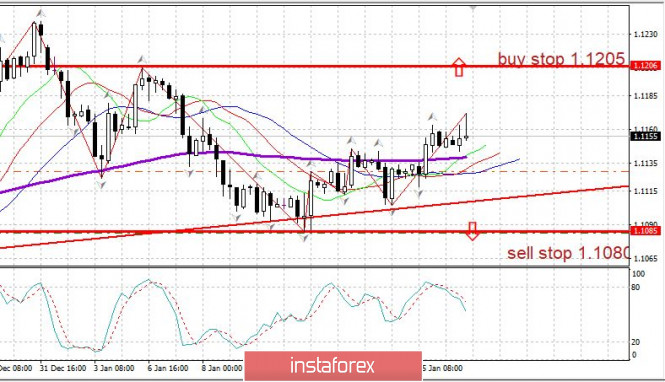
A report on retail sales in the United States was released. Sales excluding cars increased by +0.7% - significantly better than forecast. EURUSD: As we can see, buyers are not only unable to raise the euro to 1.1205, but even getting closer to this level. As they say in football: If you don't score, they will score against you. The chances of euro sellers are growing. We are ready to sell the euro from 1.1085 - with the target of 1.0850. Possible sales from 1.1104. The material has been provided by InstaForex Company - www.instaforex.com |
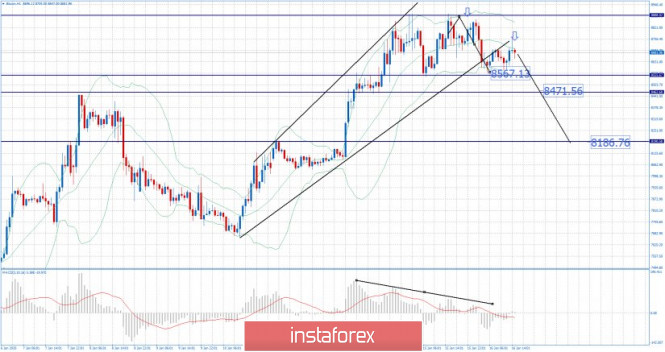
| BTC analysis for 01.16.2020 - Is this end of the upward correction ? Watch for selling opportunities Posted: 16 Jan 2020 05:51 AM PST Industry news: In a Jan. 15 announcement on Binance's Japanese support website, the exchange revealed it would restrict access to residents of Japan at an unspecified later date. The restriction is said to be implemented gradually, with details to be revealed later, according to the announcement. Currently, there are no restrictions in place and Japanese users are able to operate the exchange normally. Binance was previously headquartered in Japan after exiting China. As Cointelegraph reported in March 2018, the exchange moved its operations to Malta following an official warning by Japanese regulators due to its lack of a national exchange license. Technical analysis:
Bitcoin has been trading inside of the consolidation at the price of $8.677 and potential for the further downside movement. I do see potential completion of the upward cycle, which is a sign that selling is in play... Watch for selling opportunities and targets at the price of $8.470 and $8.186. MACD oscillator did show big decreasing to the upside momentum, which was one of the main reasons for most recent downside swing. Resistance levels are seen at the price of $8.700 and $8.888 Support levels are set at the price of $8.560, $8.470 and at the price of $8.186. The material has been provided by InstaForex Company - www.instaforex.com |
| Posted: 16 Jan 2020 04:55 AM PST
A trade war is a complex and lengthy process. No analyst or expert in the world can fully cover and analyze all aspects of trade disputes between the two largest economies in the world. Opinions among analysts about the signing of the "first phase" trade agreement between Beijing and Washington are divided. Some believe that Trump outplayed himself and did not achieve his goals, some believe that the "deal" for China is like suicide. In this article, we will look at the entire situation on the part of the United States. The main thing that all experts agree on is that ordinary consumers and businesses in America pay for Donald Trump's trade battles. A banal logical chain: Trump imposes duties on imports from China, Chinese goods become more expensive in America, consumers pay more money for the same goods. Donald Trump wanted to achieve several goals at once with the war with China, one of which is to stimulate the consumption of American goods, which would stimulate American production and, consequently, employment growth and economic growth. However, in practice, it turned out that even with 25% of duties, many goods from China are still cheaper than their American counterparts, so American consumers who previously bought Chinese goods continued to buy them after the introduction of duties. The same goes for business. It should be understood that China does not export goods to America at the state level. American companies make purchases in China for further resale. Accordingly, again, losses were incurred either by businesses that import from China or by the end consumers for whom prices rose. Many experts also note that the "first phase" agreement is the easiest part of the overall deal. Trump wants to force Beijing to stop stealing technology, financing and supporting Chinese companies, which leads to unfair international competition and reduces the trade deficit with China. Such complex tasks are unlikely to be solved by banal negotiations, and even in a short time. After all, Trump wants to get as many bonuses as possible for the November presidential election to increase his chances of winning. It turns out that Trump started the war to strengthen the US economy by weakening its main competitors: China, Europe, Canada, and Mexico. Agreements with many countries were broken, and the system of WTO rules was destroyed. The IMF estimated that Trump's trade wars have already cost the world $700 billion. Trump himself said a year and a half ago that "trade wars are good and easy to win." Approximately this thesis was stated in George Orwell's immortal novel "1984": "war is peace, peace is war." For Donald Trump, the way forward is through constant conflicts, wars with other countries. It may even produce results, or it may lead to something irreversible and destructive. Moreover, various economic theories have stated that if a large country, such as the United States, imposes import duties, it will force producers to lower prices (which will lead to a weakening of the producing countries). However, in practice, prices were not reduced, so imported goods simply rose in price in the States. In this situation, it is very useful to pay attention to the main indicator of the state of any economy – GDP. In the last two quarters in the US, it was +2.0% and +2.1% y/y. In the first quarter, it was +3.1%, and in the quarter before that, it was only +1.1%. It is believed that the GDP growth rate of more than 2.5% is high. Thus, it is safe to say that the US economy either does not respond to Trump's trade wars, or on the contrary, loses its growth rate. And how can we not remember the "secret" monetary injections into the economy of the Fed... The material has been provided by InstaForex Company - www.instaforex.com |
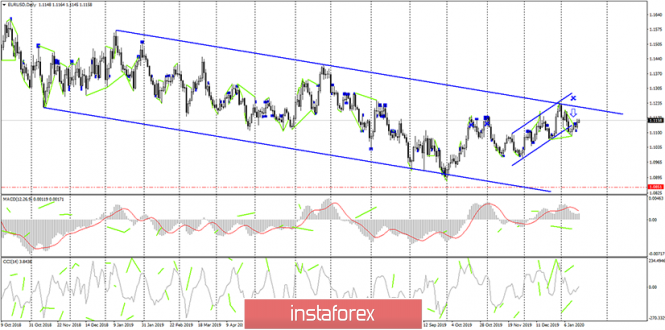
| EUR/USD. January 16. The long-term trading idea persists. Perspective – 1.0851 Posted: 16 Jan 2020 04:06 AM PST EUR/USD - Daily.
As seen on the 24-hour chart, the EUR/USD pair continues the growth process in the direction of the upper line of the downward trend corridor, which predicts a further decline in the quotes of the euro-dollar pair. Two sales signals were received earlier. First, a retreat from the upper line of the corridor. Second, a closure under the small upward corridor. At the moment, the pair's quotes are recovering, which calls into question the development of both the signal and the trading idea, however, in the area of 1.1160-1.1200, the pair can perform a new turn in favor of the US currency and make a new approach to a drop of 350 points. The idea is a bit risky, however, a fairly solid Take Profit can attract traders to new sales in the area of 1.1160-1.1200. The information background is now also on the side of the US dollar. Reports on industrial production in the EU and the consumer price index in Germany were weak. Inflation in the US, on the contrary, rose to 2.3% y/y. Thus, both the "foundation" and the "chart" predict a fall. Unfortunately, even when all the factors indicate a certain movement, it does not always come true. Forecast for EUR/USD and trading recommendations: The long-term trading idea remains in force, as the pair's quotes performed a consolidation under the upward small corridor on the 24-hour chart. Traders still have a target for a fall near the level of 1.0850. Terms of execution - 2-3 weeks. All short-term trading ideas are canceled. The material has been provided by InstaForex Company - www.instaforex.com |
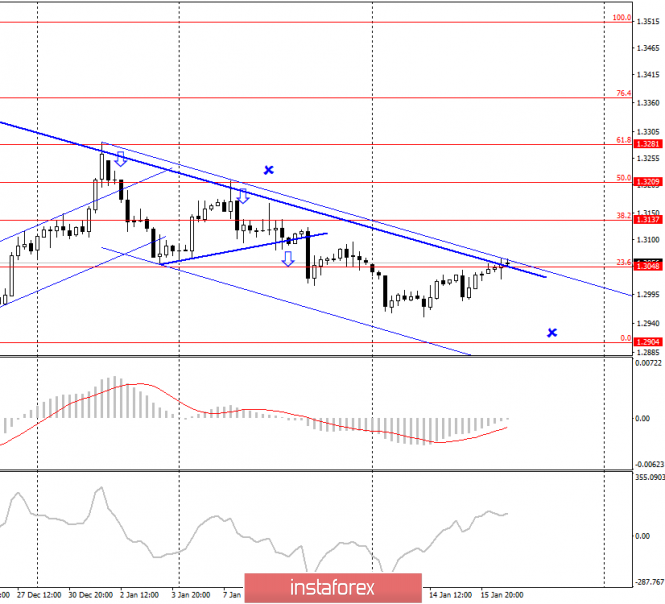
| GBP/USD. January 16. Two channels at once resist further growth of the pound Posted: 16 Jan 2020 04:06 AM PST GBP/USD - 4H.
As seen on the 4-hour chart, the GBP/USD pair returned to the corrective level of 23.6% (1.3048) and threatens to consolidate above this level, above the upper line of the downward trend corridor, as well as over the upper line of the small downtrend corridor, which I built in addition and support to the large one. Thus, closing quotes above the indicated lines will work in favor of the British pound and continued growth in the direction of the corrective level of 38.2% (1.3137). However, even if the growth of the pound is short-lived, such closure will lead to the cancellation of all previous trading signals and a trading idea that implies a fall in the pound to the corrective level of 0.0% (1.2904). Thus, we are waiting and watching the behavior of the pair and traders around the level of 1.3050. The "foundation" for the British currency this week was expressed by a weak GDP report for November, a weak report on industrial production, and weak inflation. Thus, the current growth of the pound is quite an amazing phenomenon, given the set of "graphic" factors and the information background. Forecast for GBP/USD and trading recommendations: The current trading idea is still to sell the pound with a target of 1.2904. New rebounds from the upper lines of the corridors and the level of 23.6% again allow traders to sell the pair. Going beyond these lines will cancel the trading idea. The material has been provided by InstaForex Company - www.instaforex.com |
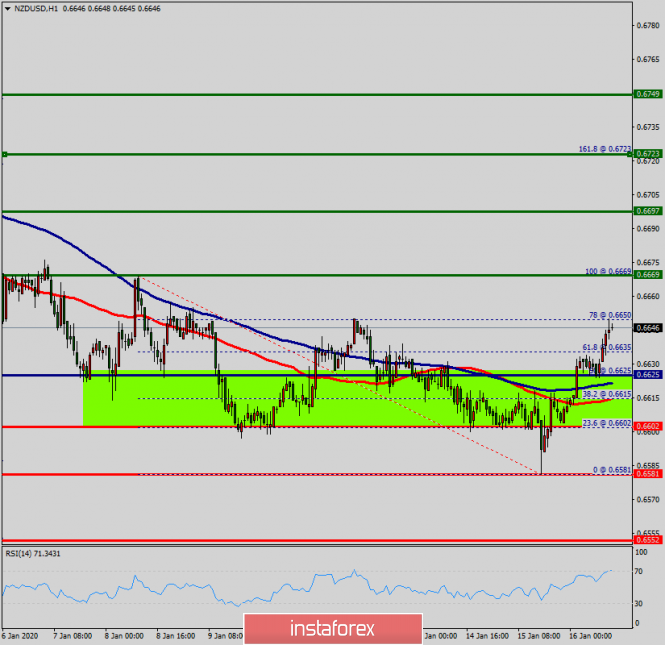
| Trading recommendations for NZD/USD for January 16, 2020 Posted: 16 Jan 2020 03:23 AM PST Overview: The NZD/USD pair broke resistance which turned to strong support at the level of 0.6625 yesterday. The level of 0.6625 coincides with a ratio of 50% of Fibonacci, which is expected to act as major support today. The Relative Strength Index (RSI) is considered overbought because it is above 70. The RSI is still signaling that the trend is upward as it is still strong above the moving average (100 and 50). This suggests the pair will probably go up in coming hours. Accordingly, the market is likely to show signs of a bullish trend. In other words, buy orders are recommended above 0.6625 with the first target at the level of 0.6669. From this point, the pair is likely to begin an ascending movement to the point of 0.6669 and further to the level of 0.6697. Further close above the high end may cause a rally towards 0.6949. Nonetheless, the weekly resistance level and zone should be considered. The level of 0.6949 will act as strong resistance and the double top is already set at the point of 0.6949. Trading recommendations for NZD/USD for January 16, 2020 According to previous events, the NZD/USD pair has still been moving between the level of 0.6625 and the 0.6697 level. It should be noted that the 0.6669 price (around double top at the level of 1.3892) will act as a strong resistance on January 16, 2020. Therefore, it will be too gainful to buy above the price of 0.6625 in order to look for further upside with 0.6669 and 0.6697 targets. It should also be reminded that stop loss must never exceed the minimum exposure amounts. Thus, stop loss should be placed at the 0.6602 level today. The material has been provided by InstaForex Company - www.instaforex.com |
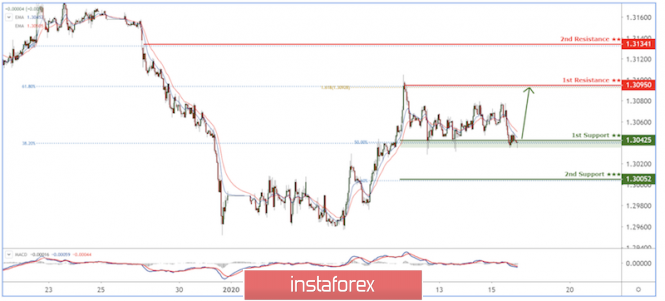
| USD/CAD bounce in progress above support! Posted: 16 Jan 2020 02:01 AM PST
Trading Recommendation Entry: 1.30425 Reason for Entry: 50% and 38.2% Fibonacci retracement, graphical swing low Take Profit : 1.30950 Reason for Take Profit: 161.80% Fibonacci extension, 61.8% Fibonacci retracement, horizontal swing high Stop Loss: 1.30052 Reason for Stop loss: 78.6% Fibonacci retracement The material has been provided by InstaForex Company - www.instaforex.com |
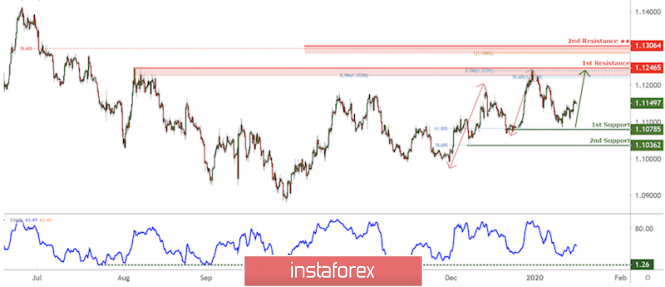
| EUR/USD bouncing off support, potential for further rise! Posted: 16 Jan 2020 02:00 AM PST
Trading Recommendation Entry: 1.10785 Reason for Entry: horizontal swing low support, 61.8% fibonacci retracement Take Profit : 1.12465 Reason for Take Profit: 78.6% Fibonacci retracement, 78.6% Fibonacci extension, horizontal swing high resistance Stop Loss: 1.10700 Reason for Stop loss: horizontal swing low support, 78.6% Fibonacci retracement The material has been provided by InstaForex Company - www.instaforex.com |
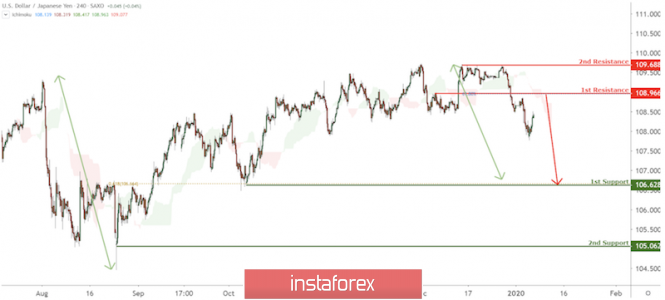
| USD/JPY potential bounce coming! Posted: 16 Jan 2020 01:58 AM PST
Entry:106.71 Reason for Entry: 61.8% Fibonacci extension Take Profit :108.42 Reason for Take Profit: 61.8% Fibonacci retracement Stop Loss: 105.06 Reason for Stop loss: Horizontal swing low support The material has been provided by InstaForex Company - www.instaforex.com |
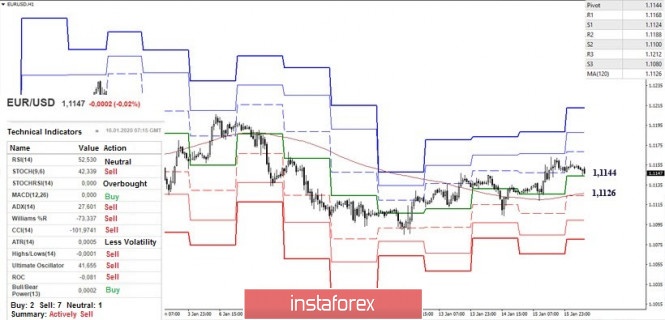
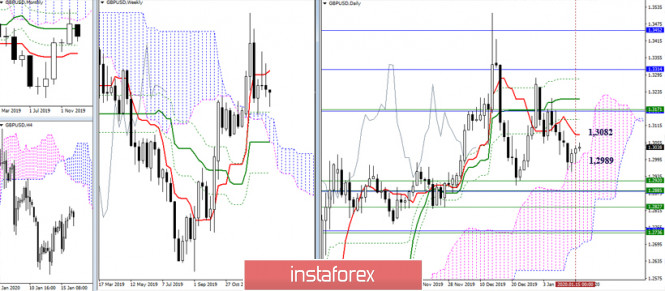
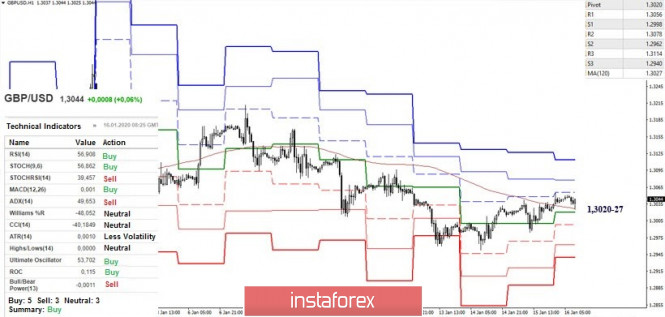
| Technical analysis recommendations for EUR/USD and GBP/USD on January 16 Posted: 16 Jan 2020 12:54 AM PST Economic calendar (Universal time) The most significant indicators of the economic calendar are expected today at 13:30 - the basic index of retail sales (USA) and the change in the volume of retail trade (USA). EUR / USD Players on promotion do not abandon attempts to achieve something more. Their interests now rest against the resistance of the daily dead cross (1.1172 final line + 1.1152-45 Tenkan - Kijun), strengthened by the monthly short-term trend (1.1145). The opportunity to consider further plans and upward prospects will appear only after a reliable breaking through of these resistances. In the meantime, this rise has the properties of a retest, a return to the levels passed the day before, with a concentration of forces to break through the resistance encountered in the form of a weekly cross and a day cloud (1.1110 - 1.1065 - 1.1022). On the other hand, there is a discrepancy in the preferences of the analyzed technical instruments in the current movement. The key support is now defending the bullish interests at 1.1144 (central Pivot level) and 1.1126 (weekly long-term trend), while the subsequent upward orientations in the form of resistance of the classic Pivot levels are located today at 1.1168 - 1.1188 - 1.1212 . The loss of support, reinforced by the active majority of technical indicators, will contribute to the return and increase of bearish sentiment. The main task for which will be the restoration of a downward trend (1.1085). GBP / USD Meanwhile, braking from the meeting of the upper border of the daytime cloud (1.2989) continues. As a result, the pair is developing a slow corrective rise to the resistance of the daily short-term trend (1.3082). Thanks to this, the situation does not change much in its conclusions and expectations. Now, subsequent resistances are located at 1.3137 - 1.3171 - 1.3209, while support remains at 1.2920 - 1.2882 - 1.2785. Players on the upside managed to rise above key levels of the lower halves of 1.3020-27 (central Pivot level + weekly long-term trend). Using them as support can now strengthen bullish positions. Today, upward milestones within the day are 1.3056 - 1.3078 - 1.3114. Now, loss of support will return the pair to the afternoon cloud, making the bears' main goal to be fixed in it. Support for the classic pivot levels within the day are located at 1.2998 - 1.2962 - 1.2940 today. Ichimoku Kinko Hyo (9.26.52), Pivot Points (classic), Moving Average (120) The material has been provided by InstaForex Company - www.instaforex.com |
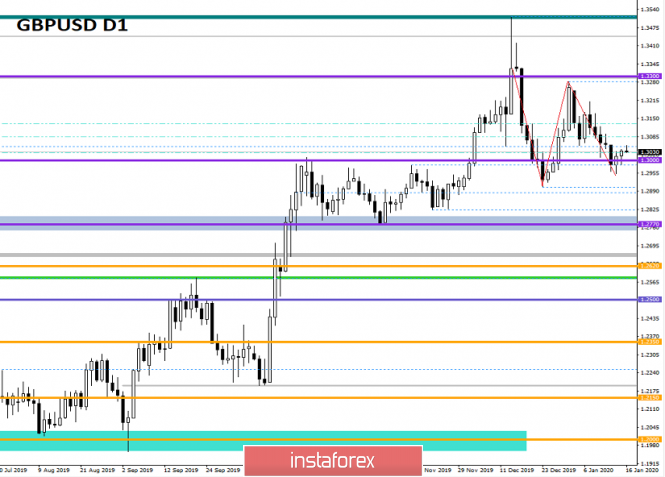
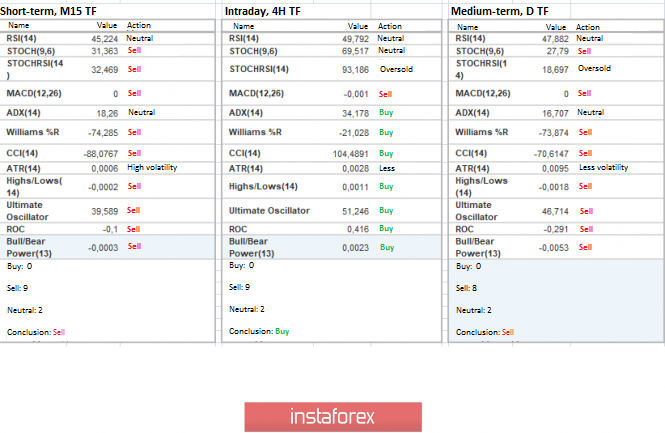
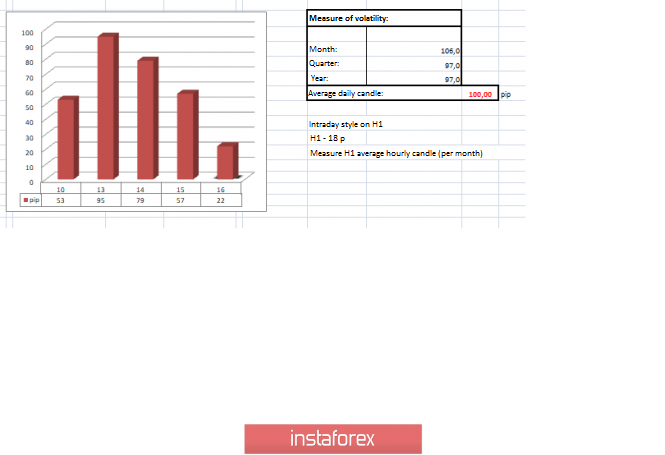
| Trading recommendations for GBPUSD for January 16, 2020 Posted: 16 Jan 2020 12:51 AM PST From a complex analysis point of view, we see a gradual upward course, where the quotes are still under pressure from the psychological level of 1.3000, considering the coordinates as a conditional support point. In fact, we have an attempt to confirm the previously posed theory of the Zigzag-shaped model dated 12/03/19 to 01/14/20, where the quotes quite accurately draw the next measure. In the case of maintaining the mood, we will see the embodiment of tact in the direction of 1.3122. At the same time, another discussion arose among traders, which considers the current fluctuation as a local strengthening of the pound, but retaining its characteristic's ambiguity. It still has restraining factors that can affect the formation of lateral movement after an upward oscillation. The two theories that we have touched on are somewhat similar since in a general examination of the trading chart, the quotes are already moving sideways with an extremely large swing range, and the current compression seems to prepare the quotes for something more. In terms of volatility, we have a rather interesting picture, where, from the beginning of the trading week the average daily amplitude decreases we simply say, 95; 79; 57 points, which suggests the preparation for the future rally. Meanwhile, from an emotional component point of view, we see that on a daily basis, there are impulse candles which confirms the preservation of speculative interest in the market. Parsing the past minute by minute, we see two impulse moves [09: 30-11: 30 (Down); 12: 30-13: 00 (Up)], where the second move turned into a kind of inertia, setting a local upward movement. As discussed in the previous review, traders as early as Tuesday went into local long positions from the value of 1.3015. The emphasis in the judgment consisted of the laws of the rebound from the psychological level and the theory of the Zigzag-shaped model. Considering the trading chart in general terms [the daily period], we see that the quotes are conditionally at the top of the upward movement which was set back in early September, which means that the decline has not yet been fully played out after the local cross to 1.3513. The news background of the past day contained data on inflation in the United Kingdom, where they expected to maintain its level by 1.5%, but as a result received a decrease to 1.3%. In fact, we received one more signal of an early rate reduction by the Bank of England. Market reaction to statistics was almost instantaneous in terms of local weakening of the pound. In terms of the general informational background we had, the most significant event of the week seems to be the ceremony on signing the first phase of a trade deal in the White House with the participation of US President Donald Trump and Vice Premier of the State Council of the PRC Liu He. In fact, the process and details of the transaction were expected in advance, however, there was a noise that put pressure on the market. In turn, the Brexit continues to retain media interest. So, there was news that the European Parliament will ratify the Brexit agreement at the end of the month. At the same time, the head of the European Commission [EC], Ursula von der Leyen, noted that the transition period will begin in February, where Brussels is ready to work day and night on an agreement. "By the middle of the year, it will be clear at what stage we will be. The EC head added that Brussels is ready to move in the upcoming negotiation process as soon as possible, working day and night on an agreement, "said Ursula von der Leyen. In terms of the economic calendar, we have the statistics for the United States today. So, the rates for applications for unemployment benefits should decrease, but only by 6 thousand [Repeated -11 thousand; Primary +5 thousand.]. At the same time, we have retail sales data, which should slow down from 3.3% to 2.9%. Further development Analyzing the current trading chart, we see the conditional standing at the place where a small range of 1.3035 / 1.3055 was formed. In fact, we still have a local upward interest, and the psychological level of 1.3000 still puts pressure on the quotes. In terms of volatility, we have extremely low indicators, maybe due to the basis of compression, the very acceleration that everyone is talking about will happen. By detailing the time interval we have, we see a kind of attempt to resume the downward movement at 05:15 [time on the trading terminal], but the restraint of market participants does not allow us to leave the range. In turn, traders continue to work locally with long positions from the value of 1.3015, having a partial exit in the very range where we are now. Having a general picture of the actions, it is possible to assume that the theory of the Zigzag-shaped model is still taking place in the market, thus one should not exclude the move to the level of 1.3122 in case of price-fixing higher than 1.3055. At the same time, the formation of a flat of 1.2955 / 1.3055 is also not excluded, therefore, a partial fixation of long positions is carried out. Based on the above information, we derive trading recommendations as follows: - There are buy positions from the value of 1.3201, where the first fixations took place in the area of 1.3050. Positions are held in the direction of 1.3100 to 1.3122. If there are no deals, then it makes sense to wait until the price fixation is higher than 1.3055. - We consider selling positions in two versions: first, local positions in case of price-fixing lower than 1.3035, with the prospect of a move to 1.3000-1.2985; The second option is the main one and is considered after a clear fixation of the price lower than 1.2955. Indicator analysis Analyzing a different sector of timeframes (TF), we see that the indicators of technical instruments are based on downward interest, but at the same time, locally displaying a correctional course relative to intraday periods. Volatility per week / Measurement of volatility: Month; Quarter Year Measurement of volatility reflects the average daily fluctuation, calculated for the Month / Quarter / Year. (January 16 was built taking into account the time of publication of the article) The volatility of the current time is 22 points, which is still an extremely low indicator. It is likely to assume that there is still a chance of acceleration, it is worth following the points of price-fixing. Key levels Resistance zones: 1.3180 **; 1.3300 **; 1.3600; 1.3850; 1.4000 ***; 1.4350 **. Support Areas: 1,3000; 1.2885 *; 1.2770 **; 1.2700 *; 1.2620; 1.2580 *; 1.2500 **; 1.2350 **; 1.2205 (+/- 10p.) *; 1.2150 **; 1,2000 ***; 1.1700; 1.1475 **. * Periodic level ** Range Level *** Psychological level **** The article is built on the principle of conducting a transaction, with daily adjustment The material has been provided by InstaForex Company - www.instaforex.com |
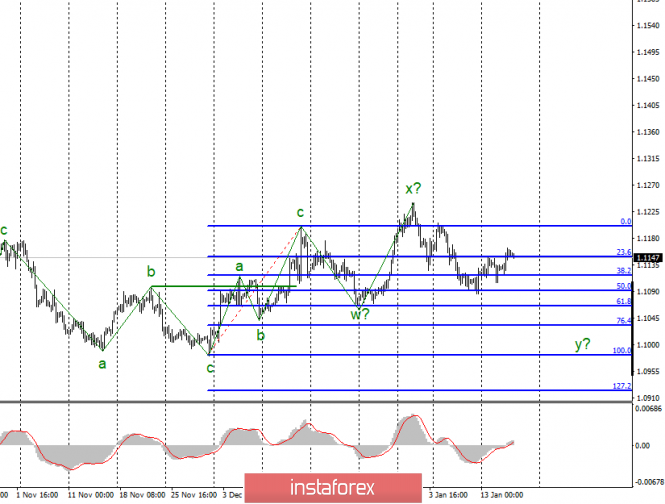
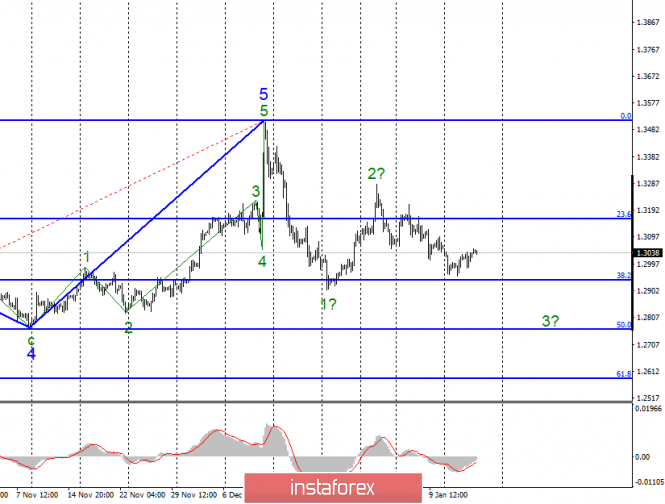
| Analysis of EUR/USD and GBP/USD for January 16. Eurozone's economic reports continue to disappoint Posted: 16 Jan 2020 12:50 AM PST EUR / USD On January 15, the EUR / USD pair gained about 20 basis points and continued to move away from previously reached lows after an unsuccessful attempt to break through the 50.0% Fibonacci level. At the same time, the alleged wave y still does not seem to be fully equipped. If this is true, then the decrease in quotes will resume with targets located near the 10th figure since I do not see any prerequisites for the resumption of the upward trend section. Fundamental component: The news background for the euro-dollar instrument was not strong, but interesting on Wednesday. The next economic report from the European Union was weaker than market expectations, weaker than forecasts. Industrial production in November declined by 1.5% yoy, a month earlier the decrease was 2.2% yoy. On a monthly basis, even an increase of 0.2% was observed, which is still worse than market expectations. Thus, the euro was supposed to lose another part of demand, but did not. The increase in quotes continues after an unsuccessful attempt to break through the level of 1.1091. Meanwhile, there were no economic reports in America yesterday, so it cannot be said that American news blocked European news. The euro added contrary to the news background. Today, markets have already witnessed German inflation for December, which turned out to be completely neutral, amounting to 1.5% y / y. This is exactly the figure that markets expected to see. On the other hand, there will be an index of business activity in the manufacturing sector of the Federal Reserve Bank of Philadelphia, as well as applications for unemployment benefits and retail sales in several variations (retail sales, retail control group and retail sales excluding cars ) in America a little later. The forecasts for US reports are higher than the values of the previous month, so improvement can be expected. I still continue to expect a resumption of the decline in the euro, believing that this option is now justified by both wave analysis and the news background. At the same time, the speech by Christine Lagarde this evening may have the greatest impact on the currency market, General conclusions and recommendations: The euro-dollar pair allegedly completed the construction of the upward trend section. Thus, I would recommend resuming sales of the instrument with targets located near the levels of 1.1034 and 1.0982, which corresponds to 76.4% and 100.0% Fibonacci, on the new MACD signal "down", which indicates the readiness of the markets to build a new downward wave of y. GBP / USD On January 15, the GBP / USD pair increased by 20 basis points and also continues to move away from previously reached lows near the level of 38.2% Fibonacci. Wave 3 also does not appear to be completed, so I expect its construction to resume with targets below the 38.2% Fibonacci level. In addition, the wave structure of the trend section, originating on December 13, can take a 3, rather than a 5-wave form. But even in this case, the quotes of the instrument should still go below the 29th figure. Fundamental component: The news background for the GBP / USD instrument was negative again on Wednesday. The consumer price index in the UK continues to decline and stopped at around 1.3% y / y in December, although markets expected to see at least 1.5% y / y. However, the harsh reality now is that the pound is very difficult to count on supporting the news background. On a monthly basis, inflation was 0.0%. The retail price index was also below forecasts - 2.2% y / y and 0.3% m / m. However, the British pound did not respond to these reports and continued a smooth increase. Given the discrepancy between the news background and the direction of movement of the pound / dollar instrument, I believe that wave 3 or c will still resume its construction and this should happen in the near future. General conclusions and recommendations: The pound / dollar instrument continues to build a new downward trend. I recommend selling the instrument with targets located near 1.2764 again, which corresponds to the Fibonacci level of 50.0%, with the new MACD signal "down", as wave 3 does not yet look fully occupied. The material has been provided by InstaForex Company - www.instaforex.com |
| Trader's Diary: EUR/USD on 01/16/2020, What did the fed say? Posted: 16 Jan 2020 12:46 AM PST
The main news for Thursday morning was about the signing of a trade agreement between the US and China, after all their constant disputes and disagreements. Finally, those who feared an expansion of the Trump-China trade war can now relax and exhale. Second, is the release of the fed's Beige Book report on the state of the US economy, as always, exactly two weeks before the fed's decision on rates. The report is replete with the words "moderate" and "very moderate." Despite the fact that we are talking about a clear slowdown in the US economy and most of all, the fact that its industry is lagging behind as there is no growth for several months. The main driver of growth is an increase in hiring, salary growth, and sales growth. In this regard, it is important to look at the new retail sales report today on Thursday at 13:30 UTC. EUR USD: Consolidation continues with high chances of going up. Buy from 1.1205. Sell from 1.1085. The material has been provided by InstaForex Company - www.instaforex.com |





 Trading Recommendation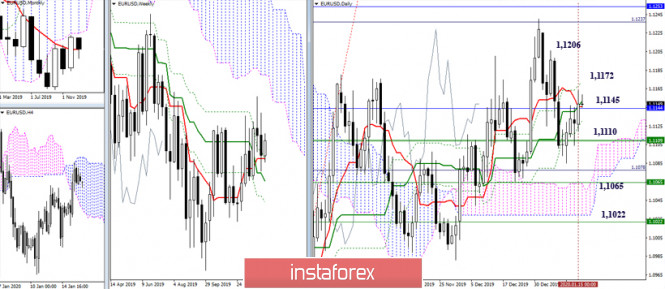

| You are subscribed to email updates from Forex analysis review. To stop receiving these emails, you may unsubscribe now. | Email delivery powered by Google |
| Google, 1600 Amphitheatre Parkway, Mountain View, CA 94043, United States | |

No comments:
Post a Comment