The Surprising Formula for Successful Investing

 
Liberty Through Wealth

SPONSORED

The Most Powerful People in the World Are RAVING About a Technology We Call "Nexus"

Nexus Technology
 

Elon Musk calls it "brilliant."

Warren Buffett says it's "ingenious."

Alibaba CEO Jack Ma dubs it the "key that opens a treasure chest."

And Amazon, Facebook, Google, IBM and Microsoft are going ALL-IN on this disruptive technology.

The mind-blowing details are here...

Action Required! Don't let this be your last issue. To ensure you continue to receive Liberty Through Wealth, confirm your email address now.

Note from Senior Managing Editor Christina Grieves: In today's article, Nicholas Vardy writes about the impact of investor psychology. He has also written many times about the importance of recognizing black swan events - rare, unexpected and high-impact events, such as the coronavirus pandemic.

And what is Nicholas' No. 1 rule to protect yourself from these events? Set trailing stops. He says, "Implementing this one rule will do wonders for your long-term returns - and psychological health - when the bear market does arrive."

In fact, trailing stops are a key component of many of our Oxford Club products, which is why Alexander Green and Chief Income Strategist Marc Lichtenfeld have teamed up for a special event that will show exactly why trailing stops are so important, and even reveal a way that they can potentially help you realize four times higher gains.

If you want to learn more, make sure to register for Alex and Marc's special 4X Stock Booster Summit on December 29. It's completely free to attend. Simply click here to reserve your spot.

THE SHORTEST WAY TO A RICH LIFE

The Single Most Important Quality of Successful Investors

Nicholas Vardy | Quantitative Strategist | The Oxford Club

Nicholas Vardy

When I started my career in investing, I thought the key to becoming a great investor was to study modern financial theory.

After all, that was how academics like Harry Markowitz of the University of Chicago and William Sharpe of Stanford won Nobel Memorial Prizes in economics.

Later, I decided to study the beliefs, habits and strategies of the world's greatest investors.

I spent thousands of dollars with one of the world's leading trading coaches, profiled in Jack Schwager's classic, Market Wizards: Interviews with Top Traders.

I also studied technical analysis and alternative investments, and even finished a course on investing at Oxford University's Saïd Business School.

Here's the conclusion I came to...

You can master the mathematics of quantitative finance. You can learn to calculate the value of options with Nobel Prize-winning formulas. You can apply dozens of technical indicators.

But none of these skills will necessarily improve your investment returns.

So when people ask me what improved my own investing the most, I give them a surprising answer.

I tell them it was my study of history and psychology.

SPONSORED

Get This Bestseller In Your Christmas Stocking (WITHOUT Paying Retail or Shipping!)

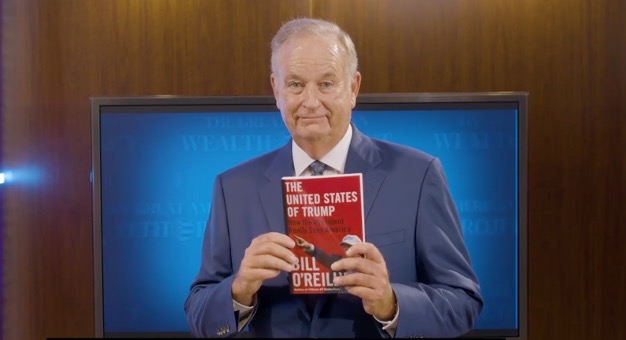
OReilly Holding Book
 

"As part of The Great American Wealth Project , we talked a lot about my new book, The United States of Trump," Bill O'Reilly said.

"And it makes a great Christmas gift. You can get it into that big stocking!"

>> CLICK HERE to see how to claim your hardcover today - a $28 value - without paying retail or shipping!

There Is Nothing New Under the (Financial) Sun

Successful investing is all about understanding the big picture. And about rising above the daily noise of the market.

And understanding the big picture means understanding financial history.

As Mark Twain purportedly observed, "History doesn't repeat itself, but it rhymes."

Alas, history is not exactly Wall Street's strong suit.

As the Harvard economist John Kenneth Galbraith also observed, "The financial memory is very short."

Studying financial history reminds you that markets move in cycles.

Some of those cycles are seasonal. "Sell in May and go away" means you will make most of your money in the six months between November 1 and April 30.

Some cycles are political. The presidential election cycle tells us that the third year of a presidential term is generally the strongest one. Presidents work hard to boost the market to improve their chances of reelection.

Some cycles are linked to the latest hot investment theme. Ten years ago, it was the "China miracle." Five years ago, it was 3D printing. Last year, it was FAANG stocks and cryptocurrencies. Tomorrow, it may be artificial intelligence.

Understanding that each theme is just a fleeting fashion allows you to ride the trend both up... and down.

Profitable Investing: 100% Psychology

Trading coach Van Tharp argues that successful investing is 100% psychology.

Here's why I agree with him...

You can subscribe to the best trading system in the world. But if you don't follow its rules consistently, you won't make any money.

The weakest link in any financial trader's "system" is his psychology.

On Wall Street, there's a rule of thumb that you should never invest with a portfolio manager who is going through a divorce.

Their unstable psychology will make them prone to many errors in judgment. Successful investing is more emotional stability than rocket science.

As Warren Buffett says, "If you have a 150 IQ, sell 30 points to someone else. You need to be smart, but not a genius."

History + Psychology = Patience

The importance of history and psychology is perhaps best seen in the virtue of patience.

In practice, this means limiting the number of ideas you act on.

As global investor Jim Rogers puts it...

One of the best rules anybody can learn about investing is to do nothing, absolutely nothing, unless there is something to do... I just wait until there is money lying in the corner, and all I have to do is go over there and pick it up... I wait for a situation that is like the proverbial "shooting fish in a barrel."

Buffett calls this "waiting for the fat pitch." Buffett is doing just that today.

His Berkshire Hathaway is sitting on $128 billion in cash. And it is a drag on Berkshire's returns today. Just like its $15 billion was in 1998 - and its $43 billion was in 2004 - before Buffett made sweetheart deals to boost Berkshire's long-term returns.

Buffett knows his history - and has the psychological discipline to be patient.

Like Rogers, Buffett is waiting for the fish in the barrel.

I suggest you do the same.

Good investing,

Nicholas Vardy

P.S. My favorite book on financial history is Edward Chancellor's Devil Take the Hindmost: A History of Financial Speculation. It traces the origins of financial speculation back to ancient Rome and chronicles its revival in the modern world.

For the latest news from Nicholas, connect on Facebook and Twitter.

SPONSORED

Is your name on one of these lists?

Bryan List
 

If so, the government is holding a check for you.

940 MILLION of these checks are waiting to be claimed.

Follow these three steps.

No comments:

Post a Comment