Get a load of this. One of the most important signals of whether you should buy or sell a stock is the activity of executives at a company. If CFOs and CEOs are buying the stock, you should not short the stock. On the other hand, if CFOs and CEOs have recently sold the stock, you should consider moving onto another buying opportunity. That comes from a study called "Do Insiders Exploit Anomalies?" It was co-written by a University of Michigan professor Nejat Seyhun in 2018.
| | | | | | | | Dear Reader,
Get a load of this.
One of the most important signals of whether you should buy or sell a stock is the activity of executives at a company.
If CFOs and CEOs are buying the stock, you should not short the stock.
On the other hand, if CFOs and CEOs have recently sold the stock, you should consider moving onto another buying opportunity.
That comes from a study called "Do Insiders Exploit Anomalies?" It was co-written by a University of Michigan professor Nejat Seyhun in 2018.
Now, that was a study that changed my perception of the markets.
And you should follow this rule.
But let me show you a different study that might make your eyes bulge.
Check this out.
Perfect Timing, Pal
S. Burcu Avci of the Sabanci University School of Business in Turkey; Cindy Schipani and Nejat Seyhun, (both at the University of Michigan), and Andrew Verstein of the UCLA School of Law wrote a paper called "Insider Giving."
The paper argues that insiders are extremely good at timing the "giving" of their stocks to charities, non-profits, and other organizations.
How good are they?
Take shares of Eastman Kodak (KODK) for example.
In 2020, company director George Karfunkel donated stock when it was trading at roughly $60 per share. This was a stock that went from nearly $2 on July 27, 2020 to that $60 level in three days on rumors that the company would produce COVID-19 vaccines.
The stock fell off a cliff after media outlets dispelled the rumors. And on August 3, Kodak received word from Karfunkel that he had donated the stock. Even though the stock had now fallen under $15, Karfunkel noted that the gift date of the stock was July 29. That was the date that the stock hit a recent high.
Now, you might look at this study and think, "Wow! These insiders must know the exact time to donate."
But let's take a step back. Remember, there isn't any significant oversight to the reporting of these charitable donations. It's not like the SEC makes a phone call and asks for the transaction receipt.
So, what's happening? First, the executives can go back in time and alter the exact, optima date to unload their stock. Then, effectively, they "donate" the stock when it is traded at the highest level.
This ensures that they can maximize the tax writeoff. The study notes that gifts can be reported more than 400 days after the date of the giving. This is a huge regulatory shift from straight up insider sales, which have to be reported in less than three days to regulators.
In the study, the authors note that Karfunkel isn't the only person who was able to potentially backdate the gift. They looked at all charitable gifts of stock dating back from 1986 to 2020. The report indicates that the timing of these gifts were usually right around the near-term top for the stock.
Overall, they saw 9,000 charabible donations of stock. The study examined the transfer of more than two billion shares and a value of about $50 billion.
The professor believes that this practice costs the U.S. government millions of dollars in excess tax write offs each year. Yep, it's just another loophole, properly timed.
It's enough to make your head spin.
There are two different stock markets—one for the protected and one for the rest of us. We know the game's rigged, and this is just another example of how.
It's also a good reminder that these little loopholes exist for a reason.
I follow insider buying and selling because it can have a profound return on investment. But this threw me off just a little bit, and I wanted to tell you about it.
What Insider Stock Am I Watching?
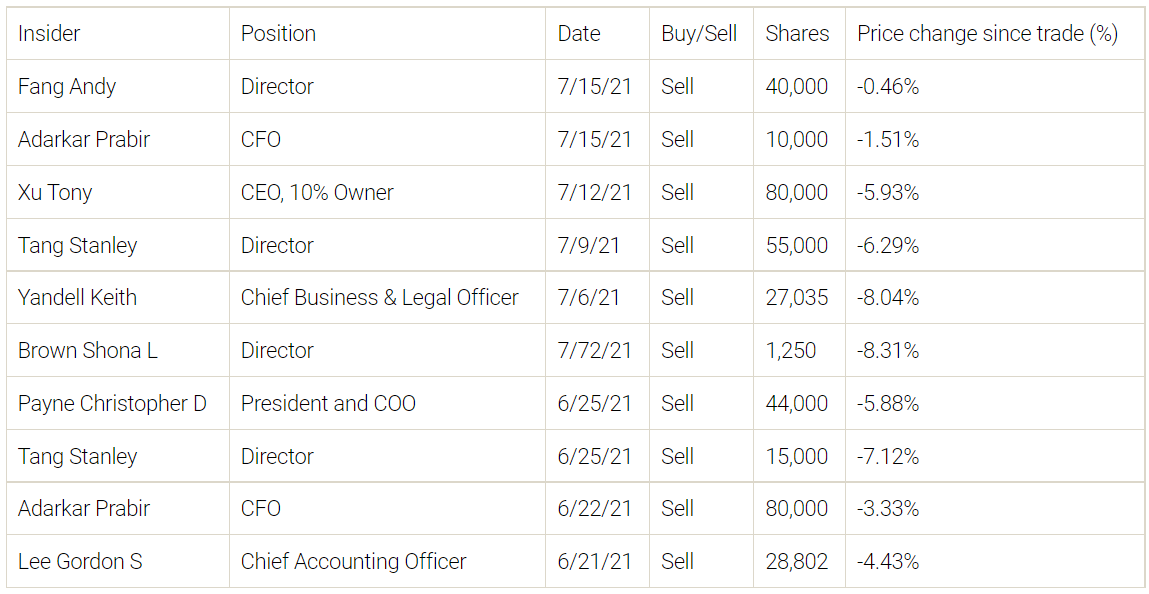
Remember, I'm looking for insider buying by CEOs and CFOs. I'm looking for "cluster selling – or the sales of the stock by many different insiders all at once.
Doordash (DASH) has experienced profound insider selling over the last month. And the stock has reflected that sales.
|
|
| | |
I get a lot of questions about where investors can obtain this information. For me, I use Gurufocus, which is pretty expensive for an annual subscription. But it's worth it.
Meanwhile, you can get a lot of this information on FinViz.
Remember, I'll bring you a lot of insider buying and selling activity every week here at Haven Investment Letter.
I'll select my top Insider stocks for you to watch.
Tomorrow, however, pay close attention to the emerging value stocks from the ongoing weakness in market momentum and the rotation out of small-cap stocks.
Enjoy your Tuesday, |
|
| | | | | | |
|
|





No comments:
Post a Comment